
A Single Network Future.

How to think about a single network future? What does it entail, and what is it good for?

Well, imagine a world where your mobile device, unchanged and unmodified, connects to the nearest cell tower and satellites orbiting Earth, ensuring customers will always be best connected, getting the best service, irrespective of where they are. Satellite-based supplementary coverage (from space) seeks to deliver on this vision by leveraging superior economic coverage in terms of larger footprint (than feasible with terrestrial networks) and better latency (compared to geostationary satellite solutions) to bring connectivity directly to unmodified consumer handsets (e.g., smartphone, tablet, IoT devices), enhance emergency communication, and foster advancements in space-based technologies. The single network future does not only require certain technological developments, such as 3GPP Non-Terrestrial Network standardization efforts (e.g., Release 17 and forward). We also need the regulatory spectrum policy to change, allowing today’s terrestrially- and regulatory-bounded cellular frequency spectra to be re-used by satellite operators providing the same mobile service under satellite coverage in areas without terrestrial communications infrastructure, as mobile customers enjoy within the normal terrestrial cellular network.

It is estimated that less than 40% of the world’s population, or roughly 2.9 billion people, have never used the internet (as of 2023). That 60% of the world population have access to internet and 40% have not, is the digital divide. A massive gap most pronounced in developing countries, rural & remote areas, and among older populations and economically disadvantaged groups. Most of the 2.9 billion on the wrong side of the divide live in areas lacking terrestrial-based technology infrastructure that would readily facilitate access to the internet. It lacks the communications infrastructure because it may either be impractical or (and) un-economical to deploy, including difficulty in monetizing and yielding a positive return on investment over a relatively short period. Satellites that are allowed by regulatory means to re-use terrestrially-based cellular spectrum for supplementary (to terrestrial) coverage can largely solve the digital divide challenges (as long as affordable mobile devices and services are available to the unconnected).

This blog explores some of the details of the, in my opinion, forward-thinking FCC’s Supplementary Coverage from Space (SCS) framework and vision of a Single Network in which mobile cellular communication is not limited to tera firma but supplemented and enhanced by satellites, ensuring connectivity everywhere.

SUPPLEMENTARY COVERAGE FROM SPACE.

Federal Communications Commission (FCC) recently published a new regulatory framework (“Report & Order and further notice of proposed rulemaking“) designed to facilitate the integration of satellite and terrestrial networks to provide Supplemental Coverage from Space (SCS), marking a significant development toward achieving ubiquitous connectivity. In the following, I will use the terms “SCS framework” and ” SCS initiative” to cover the reference to the FCC’s regulatory framework. The SCS initiative, which, to my knowledge, is the first of its kind globally, aims to allow satellite operators and terrestrial service providers to collaborate, leveraging the spectrum previously allocated exclusively for terrestrial services to extend connectivity directly to consumer handsets, what is called satellite direct-to-device (D2D), especially in remote, unserved, and underserved areas. The proposal is expected to enhance emergency communication availability, foster advancements in space-based technologies, and promote the innovative and efficient use of spectrum resources.

The “Report and Order” formalizes a spectrum-use framework, adopting a secondary mobile-satellite service (MSS) allocation in specific frequency bands devoid of primary non-flexible-use legacy incumbents, both federal and non-federal. Let us break this down in a bit more informal language. So, the FCC proposes to designate certain parts of the radio frequency spectrum (see below) for mobile-satellite services on a “secondary” basis. In spectrum management, an allocation is deemed “secondary” when it allows for the operation of a service without causing interference to the “primary” services in the same band. This means that the supplementary satellite service, deemed secondary, must accept interference from primary services without claiming protection. Moreover, this only applies to locations that lack (i.e., devoid of) the use of a given frequency band by existing ” primary” spectrum users (i.e., incumbents), non-federal as well as federal primary uses.

The setup encourages collaboration and permits supplemental coverage from space (SCS) in designated bands where terrestrial licensees, holding all licenses for a channel throughout a geographically independent area (GIA), lease access to their terrestrial spectrum rights to a satellite operator. Furthermore, the framework establishes entry criteria for satellite operators to apply for or modify an existing “part 25” space station license for SCS operations, that is the regulatory requirements established by the FCC governing the licensing and operation of satellite communications in the United States. The framework also outlines a licensing-by-rule approach for terrestrial devices acting as SCS earth stations, referring to a regulatory and technological framework where conventional consumer devices, such as smartphones or tablets, are equipped to communicate directly with satellites (after all we do talk about Direct-2-Device).

The above picture showcases a moment in the remote Arizona desert where an individual receives a direct signal to the device from a Low-Earth Orbit (LEO) satellite to his or her smartphone. The remote area has no terrestrial cellular coverage, and supplementary coverage from space is the only way for individuals with a subscription to access their cellular services or make a distress call apart from using a costly satellite phone service. It should be remembered that the SCS service is likely to be capacity-limited due to the typical large satellite coverage area and possible limited available SCS spectrum bandwidth.

Additionally, the Further Notice of Proposed Rulemaking seeks further commentary on aspects such as 911 service provision and the protection of radio astronomy, indicating the FCC’s consistent commitment to refining and expanding the SCS framework responsibly. This commitment ensures that the framework will continue to evolve, adapting to new challenges and opportunities and providing a solid foundation for future developments.

BALANCING THE AIRWAVES IN THE USA.

Two agencies in the US manage the frequency spectrum, the Federal Communications Commission (FCC) and the National Telecommunications and Information Administration (NTIA) . They collaboratively manage and coordinate frequency spectrum use and reuse for satellites, among other applications, within the United States. This partnership is important for maintaining a balanced approach to spectrum management that supports federal and non-federal needs, ensuring that satellite communications and other services can operate effectively without causing harmful interference to each other.

The Federal Communications Commission, the FCC for short, is an independent agency that exclusively regulates all non-Federal spectrum use across the United States. FCC allocates spectrum licenses for commercial use, typically through spectrum auctions. A new or re-purposed commercialized spectrum has been reclaimed from other uses, both from federal uses and existing commercial uses. Spectrum can be re-purposed either because newer, more spectrally efficient technologies become available (e.g., the transition from analog to digital broadcasting) or it becomes viable to shift operation to other spectrum bands with less commercial value (and, of course, without jeopardizing existing operational excellence). It is also possible that spectrum, previously having been for exclusive federal use (e.g., military applications, fixed satellite uses, etc.), can be shared, such as the case with Citizens Broadband Radio Service (CBRS), which allows non-federal parties access to 150 MHz in the 3.5 GHz band (i.e., band 48). However, it has recently been concluded that (centralized) dynamic spectrum sharing only works in certain use cases and is associated with considerable implementation complexities. Multiple parties with possible vastly different requirements co-exist within a given band, which is a work in progress and may not be consistent with the commercialized spectrum operation required for high-quality broadband cellular operation.

Alongside the FCC, the National Telecommunications and Information Administration (NTIA) plays a crucial role in US spectrum management. The NTIA is the sole authority responsible for authorizing Federal spectrum use. It also serves as the principal adviser on telecommunications policies to the President of the United States, coordinating the views of the Executive Branch. The NTIA manages a significant portion of the spectrum, approximately 2,398 MHz (69%), within the range of 225 MHz to 3.7 GHz, known as the ‘beachfront spectrum’. Of the total 3,475 MHz, 591 MHz (17%) is exclusively for Federal use, and 1,807 MHz (52%) is shared or coordinated between Federal and non-Federal entities. This leaves 1,077 MHz (31%) for exclusive commercial use, which falls under the management of the FCC.

NTIA, in collaboration with the FCC, has been instrumental in the past in freeing up substantial C-band spectrum, 480 MHz in total, of which 100 MHz is conditioned on prioritized sharing (i.e., Auction 105), for commercial and shared use that subsequently has been auctioned off over the last three years raising USD 109 billion. In US Dollar (USD) per MHz per population count (pop), we have, on average, ca. USD 0.68 per MHz-pop from the C-band auctions in the US, compared to USD 0.13 per MHz-pop in Europe C-band auctions and USD 0.23 per MHz-pop in APAC auctions. It should be remembered that the United States exclusive-use spectrum licenses can be regarded as an indefinite-lived intangible asset, while European spectrum rights expire between 10 and 20 years. This may explain a big part of the difference between US-based spectrum pricing and Europe and Asia.

The FCC and the NTIA jointly manage all the radio spectrum in the United States, licensed (e.g., cellular mobile frequencies, TV signals) and unlicensed (e.g., WiFi, MW Owens). The NTIA oversees spectrum use for Federal purposes, while the FCC is responsible for non-Federal use. In addition to its role in auctioning spectrum licenses, the FCC is also authorized to redistribute licenses. This authority allows the FCC to play a vital role in ensuring efficient spectrum use and adapting to changing needs.

THE SINGLE NETWORK.

The Supplementary Coverage from Space (SCS) framework creates an enabling regulatory framework for satellite operators to provide mobile broadband services to unmodified mobile devices (i.e., D2D services), such as smartphones and other terrestrial cellular devices, in rural and remote areas without such services, where no or only scarce terrestrial infrastructure exists. By leveraging SCS, terrestrial cellular broadband services will be enhanced, and the combination may result in a unified network. This network will ensure continuous and ubiquitous access to communication services, overcoming geographical and environmental challenges. Thus, this led to the inception of the Single Network that can provide seamless connectivity across diverse environments, including remote, unserved, and underserved areas.

The above picture illustrates the idea behind the FCC’s SCS framework and “Single Network” on a high level. In this example, an LEO satellite provides direct-to-device (D2D) supplementary coverage in rural and remote areas, using an advanced phase-array antenna, to unmodified user equipment (e.g., smartphone, tablet, cellular-IoT, …) in the same frequency band (i.e., f1,sat) owned and used by a terrestrial operator operating a cellular network (f1). The LEO satellite operator must partner with the terrestrial spectrum owner to manage and coordinate the frequency re-use in areas where the frequency owner (i.e., mobile/cellular operator) does not have the terrestrial-based infrastructure to deliver a service to its customers (i.e., typically remote, rural areas where terrestrial infrastructure is impractical and uneconomic to deploy). The satellite operator has to avoid geographical regions where the frequency (e.g., f1) is used by the spectrum owner, typically in urban, suburban, and rural areas (where terrestrial cellular infrastructure has already been deployed and service offered).

How does the “Single Network” of FCC differ from the 3GPP Non-Terrestrial Network (NTN) standardization? Simply put, the “Single Network” is a regulatory framework that paves the way for satellite operators to re-use the terrestrial cellular spectrum on their non-terrestrial (satellite-based) network. The 3GPP NTN standardization initiatives, e.g., Release 16, 17 and 18+, are a technical effort to incorporate satellite communication systems within the 5G network architecture. Shortly, the following 3GPP releases are it relates to how NTN should function with terrestrial 5G networks;

  • Release 15 laid the groundwork for 5G New Radio (NR) and started to consider the broader picture of integrating non-terrestrial networks with terrestrial 5G networks. It marks the beginning of discussions on how to accommodate NTNs within the 5G framework, focusing on study items rather than specific NTN standards.
  • Release 16 took significant steps toward defining NTN by including study items and work items specifically aimed at understanding and specifying the adjustments needed for NR to support communication with devices served by NTNs. Release 16 focuses on identifying modifications to the NR protocol and architecture to accommodate the unique characteristics of satellite communication, such as higher latency and different mobility characteristics compared to terrestrial networks.
  • Release 17 further advancements in NTN specifications aiming to integrate specific technical solutions and standards for NTNs within the 5G architecture. This effort includes detailed specifications for supporting direct connectivity between 5G devices and satellites, covering aspects like signal timing, frequency bands, and protocol adaptations to handle the distinct challenges posed by satellite communication, such as the Doppler effect and signal delay.
  • Release 18 and beyond will continue to evolve its standards to enhance NTN support, addressing emerging requirements and incorporating feedback from early implementations. These efforts include refining and expanding NTN capabilities to support a broader range of applications and services, improving integration with terrestrial networks, and enhancing performance and reliability.

The NTN architecture ensures (should ensure) that satellite communications systems can seamlessly integrate into 5G networks, supporting direct communication between satellites and standard mobile devices. This integration idea includes adapting 5G protocols and technologies to accommodate the unique characteristics of satellite communication, such as higher latency and different signal propagation conditions. The NTN standardization aims to expand the reach of 5G services to global scales, including maritime, aerial, and sparsely populated land areas, thereby aligning with the broader goal of universal service coverage.

The FCC’s vision of a “single network” and the 3GPP NTN standardization aims to integrate satellite and terrestrial networks to extend connectivity, albeit from slightly different angles. The FCC’s concept provides a regulatory and policy framework to enable such integration across different network types and service providers, focusing on the broad goal of universal connectivity. In contrast, 3GPP’s NTN standardization provides the technical specifications and protocols to make this integration possible, particularly within next-generation (5G) networks. At the same time, 3GPP’s NTN efforts address the technical underpinnings required to realize that vision in practice, especially for 5G technologies. The FCC’s “single network” concept lays the regulatory foundation for enabling satellite and terrestrial cellular network service integration to the same unmodified device portfolio. Together, they are highly synergistic, addressing the regulatory and technical challenges of creating a seamlessly connected world.

Depicting a moment in the Colorado mountains, a hiker receives a direct signal from a Low Earth Orbit (LEO) satellite supplementary coverage to their (unmodified) smartphone. The remote area has no terrestrial cellular coverage. It should be remembered that the SCS service is likely to be capacity-limited due to the typical large satellite coverage area and possible limited available SCS spectrum bandwidth.

SINGLE NETWORK VS SATELLITE ATC

The FCC’s Single Network vision and the Supplemental Coverage from Space (SCS) concept, akin to the Satellite Ancillary Terrestrial Component (ATC) architectural concept (an area that I spend a significant portion of my career working on operationalizing and then defending … a different story though), share a common goal of merging satellite and terrestrial networks to fortify connectivity. These strategies, driven by the desire to enhance the reach and reliability of communication services, particularly in underserved regions, hold the promise of expanded service coverage.

The Single Network and SCS initiatives broadly focus on comprehensively integrating satellite services with terrestrial infrastructures, aiming to directly connect satellite systems with standard consumer devices across various services and frequency bands. This expansive approach seeks to ensure ubiquitous connectivity, significantly closing the coverage gaps in current network deployments. Conversely, the Satellite ATC concept is more narrowly tailored, concentrating on using terrestrial base stations to complement and enhance satellite mobile services. This method explicitly addresses the need for improved signal availability and service reliability in urban or obstructed areas by integrating terrestrial components within the satellite network framework.

Although the Single Network and Satellite ATC shared goals, the paths to achieving them diverge significantly in the application, regulatory considerations, and technical execution. The SCS concept, for instance, involves navigating regulatory challenges associated with direct-to-device satellite communications, including the complexities of spectrum sharing and ensuring the harmonious coexistence of satellite and terrestrial services. This highlights the intricate nature of network integration, making your audience more aware of the regulatory and technical hurdles in this field.

The distinction between the two concepts lies in their technological and implementation specifics, regulatory backdrop, and focus areas. While both aim to weave together the strengths of satellite and terrestrial technologies, the Single Network and SCS framework envisions a more holistic integration of connectivity solutions, contrasting with the ATC’s targeted approach to augmenting satellite services with terrestrial network support. This illustrates the evolving landscape of communication networks, where the convergence of diverse technologies opens new avenues for achieving seamless and widespread connectivity.

THE RELATED SCS FREQUENCIES & SPECTRUM.

The following frequency bands and the total bandwidth associated with the frequency have by the FCC been designated for Supplemental Coverage from Space (SCS):

  • 70MHz @ 600 MHz Band
  • 96 MHz @ 700 MHz Band
  • 50 MHz @ 800 MHz Band
  • 130 MHz @ Broadband PCS
  • 10 MHz @ AWS-H Block

The above comprises a total frequency bandwidth of 350+ MHz, currently used for terrestrial cellular services across the USA. According to the FCC, the above frequency bands and spectrum can also be used for satellite direct-to-device SCS services to normal mobile devices without built-in satellite transceiver functionality. Of course, this is subject to spectrum owners’ approval and contractual and commercial arrangements.

Moreover, the 758-769/788-799 MHz band, licensed to the First Responder Network Authority (FirstNet), is also eligible for SCS under the established framework. This frequency band has been selected to enhance connectivity in remote, unserved, and underserved areas by facilitating collaborations between satellite and terrestrial networks within these specific frequency ranges.

SpaceX recently reported a peak download speed of 17 Mb/s from a satellite direct to an unmodified Samsung Android Phone using 2×5 MHz of T-Mobile USA’s PCS (i.e., the G-block). The speed corresponds to a downlink spectral efficiency of ~3.4 Mbps/MHz/beam, which is pretty impressive. Using this as rough guidance for the ~350 MHz, we should expect this to be equivalent to an approximate download speed of ca. 600 Mbps (@ 175 MHz) per satellite beam. As the satellite antenna technology improves, we should expect that spectral efficiency will also increase, resulting in increasing downlink throughput.

SCS INFANCY, BUT ALIVE AND KICKING.

In the FCC’s framework on the Supplemental Coverage from Space (SCS), the partnership between SpaceX and T-Mobile is described as a collaborative effort where SpaceX would utilize a block of T-Mobile’s mid-band Personal Communications Services (PCS G-Block) spectrum across a nationwide footprint. This initiative aims to provide service to T-Mobile’s subscribers in rural and remote locations, thereby addressing coverage gaps in T-Mobile’s terrestrial network. The FCC has facilitated this collaboration by allowing SpaceX and T-Mobile to deploy and test their proposed SCS system while their pending applications and the FCC’s proceedings continue.

Specifically, SpaceX has been authorized (by FCC’s Space Bureau) to deploy a modified version of its second-generation (2nd generation) Starlink satellites with SCS-capable antennas that can operate in specific frequencies. FCC authorized experimental testing on terrestrial locations for SpaceX and T-Mobile to progress with their SCS system, although SpaceX’s requests for broader authority remain under consideration by the FCC.

Lynk Global has partnered with mobile network operators (MNOs) outside the United States to allow the MNOs’ customers to send texts using Lynk’s satellite network. In 2022, the FCC authorized Lynk’s request to operate a non-geostationary satellite orbit (NGSO) satellite system (e.g., Low-Earth Orbit, Medium Earth Orbit, or Highly-Elliptical Orbit) intended for text message communications in locations outside the United States and in countries where Lynk has obtained agreements with MNOs and the required local regulatory approval. Lynk aims to deploy ten mobile-satellite service (MSS) satellites as part of a “cellular-based satellite communications network” operating on cellular frequencies globally in the 617-960 MHz band (i.e., within the UHF band), targeting international markets only.

Lynk has announced contracts with more than 30 MNOs (full list not published) covering over 50 countries for Lynk’s “satellite-direct-to-standard-mobile-phone-system,” which provides emergency alerts and two-way Short Message Service (SMS) messaging. Lynk currently has three LEO satellites in orbit as of March 2023, and they plan to expand their constellation to include up to 5,000 satellites with 50 additional satellites planned for end of 2024, and with that substantially broadening its geographic coverage and service capabilities​​. Lynk recently claimed that they had in Hawaii achieved repeated successful downlink speeds above 10 Mbps with several mass market unmodified smartphones (10+ Mbps indicates a spectral efficiency of 2+ Mbps/MHz/beam). Lynk Mobile has also, recently (July 2023) demonstrated (as a proof of concept) phone calls via their LEO satellite between two unmodified smartphones (see the YouTube link).

AST SpaceMobile is also mentioned for its partnerships with several MNOs, including AT&T and Vodafone, to develop its direct-to-device or satellite-to-smartphone service. Overall AST SpaceMobile has announced it has entered into “more than 40 agreements and understandings with mobile network operators globally” (e.g., AT&T, Vodafone, Rakuten, Orange, Telefonica, TIM, MTN, Ooredoo, …). In 2020, AST filed applications with the FCC seeking U.S. market access for gateway links in the V-band for its SpaceMobile satellite system, which is planned to consist of 243 LEO satellites. AST clarified that its operation in the United States would collaborate with terrestrial licensee partners without seeking to operate independently on terrestrial frequencies​​.

AST SpaceMobile BlueWalker 3 (BW3) LEO satellite 64 square-meter phased array. Source: AST SpaceMobile.

AST SpaceMobile’s satellite antenna design marks a pioneering step in satellite communications. AST recently deployed the largest commercial phased array antenna into Low Earth Orbit (LEO). On September 10, 2022, AST SpaceMobile launched its prototype direct-to-device testbed BlueWalker 3 (BW3) satellite. This mission marked a significant step forward in the company’s efforts to test and validate its technology for providing direct-to-cellphone communication via a Low Earth Orbit (LEO) satellite network. The launch of BW3 aimed to demonstrate the capabilities of its large phased array antenna, a critical component for the AST’s targeted global broadband service.

The BW3’s phased array antenna with a surface area of 64 square meters is technologically quite advanced (actually, I find it very beautiful and can’t wait to see the real thing for their commercial constellation) and designed for dynamic beamforming as one would expect for a state-of-art direct-to-device satellite. The BlueWalker 3, a proof of concept design, supports a frequency range of 100 MHz in the UHF band, with 5 MHz channels and a spectral efficiency expected to be 3 Mbps/MHz/channel. This capability is crucial for establishing direct-to-device communications, as it allows the satellite to concentrate its signals on specific geographic areas or directly on mobile devices, enhancing the quality of coverage and minimizing potential interference with terrestrial networks. AST SpaceMobile is expected to launch the first 5 of 243 LEO satellites, BlueBirds, on SpaceX’s Falcon 9 in the 2nd quarter of 2024. The first 5 will be similar to BW3 design including the phased array antenna. Subsequent AST satellites are expected to be larger with substantially up-scaled phased array antenna supporting an even larger frequency span covering the most of the UHF band and supporting 40 MHz channels with peak download speeds of 120 Mbps (using their estimated 3 Mbps/MHz/channel).

These above examples underscore the the ongoing efforts and potential of satellite service providers like Starlink/SpaceX, Lynk Global, and AST SpaceMobile within the evolving SCS framework. The examples highlight the collaborative approach between satellite operators and terrestrial service providers to achieve ubiquitous connectivity directly to unmodified cellular consumer handsets.

PRACTICAL PREREQUISITES.

In general, the satellite operator would need a terrestrial frequency license owner willing to lease out its spectrum for services in areas where that spectrum has not been deployed on its network infrastructure or where the license holder has no infrastructure deployed. And, of course, a terrestrial communication service provider owning spectrum and interested in extending services to remote areas would need a satellite operator to provide direct-to-device services to its customers. Eventually, terrestrial operators might see an economic benefit in decommissioning uneconomical rural terrestrial infrastructure and providing satellite broadband cellular services instead. This may be particularly interesting in low-density rural and remote areas supported today by a terrestrial communications infrastructure.

Under the SCS framework, terrestrial spectrum owners can make leasing arrangements with satellite operators. These agreements would allow satellite services to utilize the terrestrial cellular spectrum for direct satellite communication with devices, effectively filling coverage gaps with satellite signals. This kind of arrangement could be similar to the one between T-Mobile USA and StarLink to offer cellular services in the absence of T-Mobile cellular infrastructure, e.g., mainly remote and rural areas.

As the regulatory body for non-federal frequencies, the FCC delineates a regulatory environment that specifies the conditions under which the spectrum can be shared or used by terrestrial and satellite services, minimizing the risk of harmful interference (which both parties should be interested in anyway). This includes setting technical standards and identifying suitable frequency bands supporting dual use. The overarching goal is to bolster the reach and reliability of cellular networks in remote areas, enhancing service availability.

For terrestrial cellular networks and spectrum owners, this means adhering to FCC regulations that govern these new leasing arrangements and the technical criteria designed to protect incumbent services from interference. The process involves meticulous planning and, if necessary, implementing measures to mitigate interference, ensuring that the integration of satellite and terrestrial networks proceeds smoothly.

Moreover, the SCS framework should leapfrog innovation and allow network operators to broaden their service offerings into areas where they are not present today. This could include new applications, from emergency communications facilitated by satellite connectivity to IoT deployments and broadband access in underserved locations.

Depicting a moment somewhere in the Arctic (e.g., Greenland), an eco-tourist receives a direct signal from a Low Earth Orbit (LEO) satellite supplementary coverage to their (unmodified) smartphone. The remote area has no terrestrial cellular coverage. It should be remembered that the SCS service is likely to be capacity-limited due to the typical large satellite coverage area and possible limited available SCS spectrum bandwidth. Several regulatory, business, and operational details must be in place for the above service to work.

TECHNICAL PREREQUISITES FOR DELIVERING SATELLITE SCS SERVICES.

Satellite constellations providing D2D services are naturally targeting supplementary coverage of geographical areas where no terrestrial cellular services are present at the target frequency bands used by the satellite operator.

As the satellite operator has gotten access to the terrestrial cellular spectrum for its supplementary coverage direct-to-device service, it has a range of satellite technical requirements that either need to be in place of an existing constellation (though that might require some degree of foresight) or a new satellite would need to be designed consistent with frequency band and range, the targeted radio access technology such as LTE or 5G (assuming the ambition eventually is beyond messaging), and the device portfolio that the service aims to support (e.g., smartphone, tablet, IoTs, …). In general, I would assume that existing satellite constellations would not automatically support SCS services they have not been designed for upfront. It would make sense (economically) if a spectrum arrangement already exists between the satellite and terrestrial cellular spectrum owner and operator.

Direct-to-device LEO satellites directly connect to unmodified mobile devices such as smartphones, tablets, or other personal devices. This necessitates a design that can accommodate low-power signals and small antennas typically found on consumer devices. Therefore, these satellites often incorporate advanced beamforming capabilities through phased array antennas to focus signals precisely on specific geographic locations, enhancing signal strength and reliability for individual users. Moreover, the transceiver electronics must be highly sensitive and capable of handling simultaneous connections, each potentially requiring different levels of service quality. As the satellite provides services over remote and scarcely populated areas, at least initially, there is no need for high-capacity designs, e.g., typically requiring terrestrial cellular-like coverage areas and large frequency bandwidths. The satellites are designed to operate in frequency bands compatible with terrestrial consumer devices, necessitating coordination and compliance with various regulatory standards compared to traditional satellite services.

Implementing satellite-based SCS successfully hinges on complying with many fairly sophisticated technical requirements, such as phased array antenna design and transceiver electronics, enabling direct communication with consumer devices terrestrially. The phased array antenna, a cornerstone of this architecture, must possess advanced beamforming capabilities, allowing it to dynamically focus and steer its signal beams towards specific geographic areas or even moving targets on the Earth’s surface. This flexibility is super important for maximizing the coverage and quality of the communication link with individual devices, which might be spread across diverse and often challenging terrains. The antenna design needs to be wideband and highly efficient to handle the broad spectrum of frequencies designated for SCS operations, ensuring compatibility with the communication standards used by consumer devices (e.g., 4G LTE, 5G).
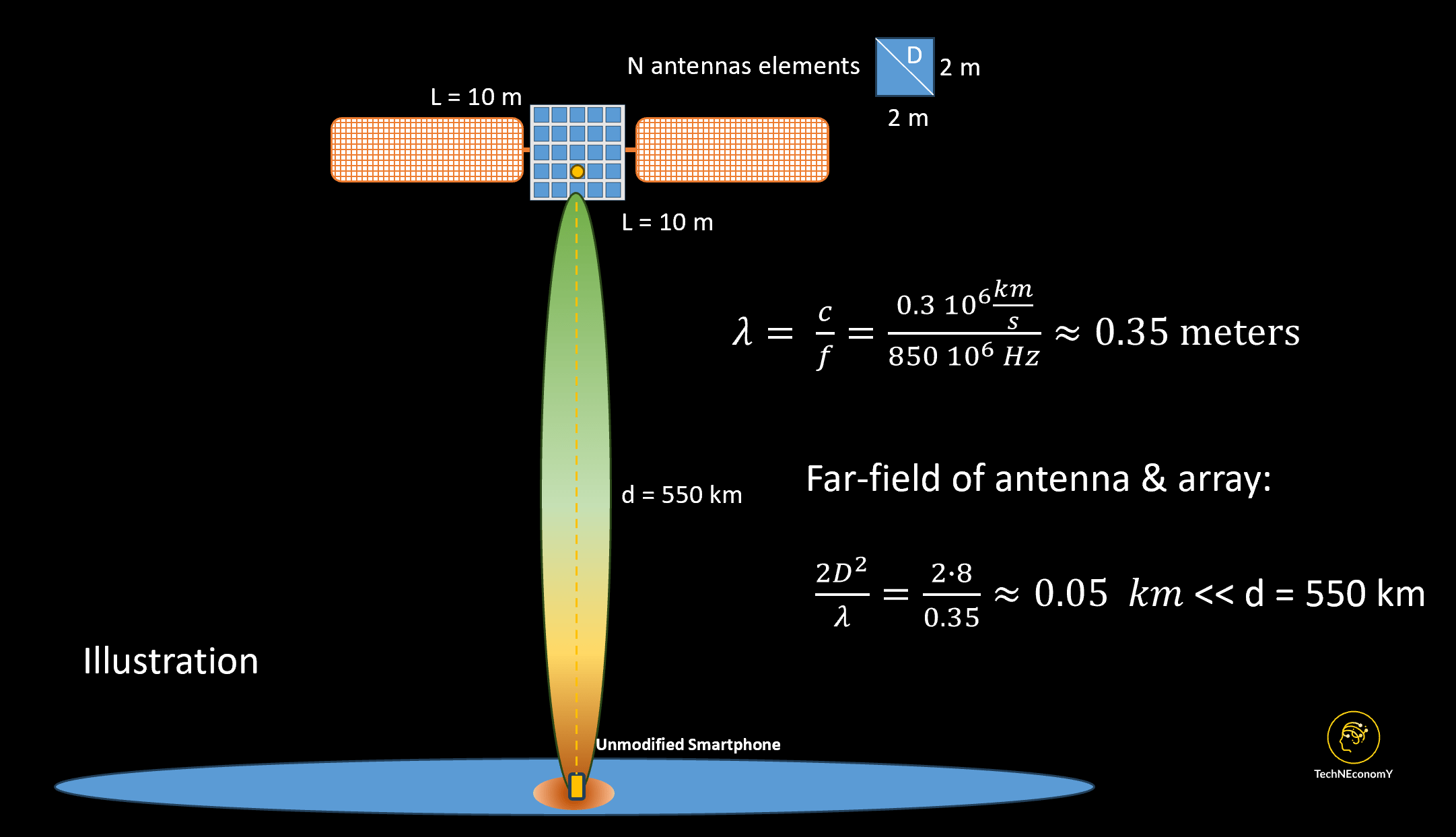
An illustration of a LEO satellite with a phased array antenna providing direct to smartphone connectivity at a 850 MHz carrier frequency. All practical purposes the antenna beamforming at a LEO altitude can be considered far-field. Thus the electromagnetic fields behave as planar waves and the antenna array becomes more straightforward to design and to manage performance (e.g., beam steering at very high accuracy).

Designing phased array antennas for satellite-based direct-to-device services, envisioned by the SCS framework, requires considering various technical design parameters to ensure the system’s optimal performance and efficiency. These antennas are crucial for effective direct-to-device communication, encompassing multiple technical and practical considerations.

The SCS frequency band not only determines the operational range of the antenna but also its ability to communicate effectively with ground-based devices through the Earth’s atmosphere; in this respect, lower frequencies are better than higher frequencies. The frequency, or frequencies, significantly influences the overall design of the antenna, affecting everything from its physical dimensions to the materials used in its construction. The spacing and configuration of the antenna elements are carefully planned to prevent interference while maximizing coverage and connectivity efficiency. Typically, element spacing is kept around half the operating frequency wavelength, and the configuration involves choosing linear, planar, or circular arrays.

Beamforming capabilities are at the heart of the phased array design, allowing for the precise direction of communication beams toward targeted areas on the ground. This necessitates advanced signal processing to adjust signal phases dynamically and amplitudes, enabling the system to focus its beams, compensate for the satellite’s movement, and handle numerous connections.

The antenna’s polarization strategy is chosen to enhance signal reception and minimize interference. Dual (e.g., horizontal & vertical) or circular (e.g., right or left hand) polarization ensures compatibility with a wide range of devices and as well as more efficient spectrum use. Polarization refers to the orientation of the electromagnetic waves transmitted or received by an antenna. In satellite communications, polarization is used to differentiate between signals and increase the capacity of the communication link without requiring additional frequency bandwidth.

Physical constraints of size, weight, and form factor are also critical, dictated by the satellite’s design and launch parameters, including the launch cost. The antenna must be compact and lightweight to fit within the satellite’s structure and comply with launch weight limitations, impacting the satellite’s overall design and deployment mechanisms.

Beyond the antenna, the transceiver electronics within the satellite play an important role. These must be capable of handling high-throughput data to accommodate simultaneous connections, each demanding reliable and quality service. Sensitivity is another critical factor, as the electronics need to detect and process the relatively weak signals sent by consumer-grade devices, which possess much less power than traditional ground stations. Moreover, given the energy constraints inherent in satellite platforms, these transceiver systems must efficiently manage the power to maintain optimal operation over long durations as it directly relates to the satellite’s life span.

Operational success also depends on the satellite’s compliance with regulatory standards, particularly frequency use and signal interference. Achieving this requires a deep integration of technology and regulatory strategy, ensuring that the satellite’s operations do not disrupt existing services and align with global communication protocols.

CONCERNS.

The FCC’s Supplemental Coverage from Space (SCS) framework has been met with both anticipation and critique, reflecting diverse stakeholder interests and concerns. While the framework aims to enhance connectivity by integrating satellite and terrestrial networks, several critiques and concerns have been raised:

Interference concerns: A primary critique revolves around potential interference with existing terrestrial services. Stakeholders worry that SCS operations might disrupt the current users, including terrestrial mobile networks and other satellite services. A significant challenge is ensuring that SCS services coexist harmoniously with these incumbent services without causing harmful interference.

Certification of terrestrial mobile devices: FCC requires that terrestrial mobile devices has to be certified SCS. The expressed concerns have been multifaceted, reflecting the complexities of integrating satellite communication capabilities into standard consumer mobile devices. These concerns, as in particular highlighted in the FCC’s SCS framework, revolving around technical, regulatory, and practical aspects. As 3GPP NTN standardization are considering changes to mobile devices that would enhance the direct connectivity between device and satellite, it may at least for devices developed for NTN communication make sense to certify those.

Spectrum allocation and management: Spectrum allocation for SCS poses another concern, particularly the repurposing of spectrum bands previously dedicated to other uses. Critics argue that spectrum reallocation must be carefully managed to avoid disadvantaging existing services or limiting future innovation in those bands.

Regulatory and licensing framework: The complexity of the regulatory and licensing framework for SCS services has also been a point of contention. Critics suggest that the framework could be burdensome for new entrants or more minor players, potentially stifling innovation and competition in the satellite and telecommunications industries.

Technical and operational challenges: The technical requirements for SCS, including the need for advanced phased array antennas and the integration of satellite systems with terrestrial networks, pose significant challenges. Concerns about the feasibility and cost of developing and deploying the necessary technology at scale have been raised.

Market and economic impacts: There are concerns about the SCS framework’s economic implications, particularly its impact on existing market dynamics. Critics worry that the framework might favor certain players or technologies, potentially leading to market consolidation or barriers to entry for innovative solutions.

Environmental and space traffic management: The increased deployment of satellites for SCS services raises concerns about space debris and the sustainability of space activities. Critics emphasize the need for robust space traffic management and debris mitigation strategies to ensure the long-term viability of space operations.

Global coordination and equity: The global nature of satellite communications underscores the need for international coordination and equitable access to SCS services. Critics point out the importance of ensuring that the benefits of SCS extend to all regions, particularly those currently underserved by telecommunications infrastructure.

FURTHER READING.

  1. FCC-CIRC2403-03, Report and Order and further notice of proposed rulemaking, related to the following context: “Single Network Future: Supplemental Coverage from Space” (February 2024).
  2. A. Vanelli-Coralli, N. Chuberre, G. Masini, A. Guidotti, M. El Jaafari, “5G Non-Terrestrial Networks.”, Wiley (2024). A recommended reading for deep diving into NTN networks of satellites, typically the LEO kind, and High-Altitude Platform Systems (HAPS) such as stratospheric drones.
  3. Kim Kyllesbech Larsen, The Next Frontier: LEO Satellites for Internet Services. | techneconomyblog, (March 2024).
  4. Kim Kyllesbech Larsen, Stratospheric Drones: Revolutionizing Terrestrial Rural Broadband from the Skies? | techneconomyblog, (January 2024).
  5. Kim Kyllesbech Larsen, Spectrum in the USA – An overview of Today and a new Tomorrow. | techneconomyblog, (May 2023).
  6. Starlink, “Starlink specifications” (Starlink.com page). The following Wikipedia resource is also quite good: Starlink.
  7. R.K. Mailloux, “Phased Array Antenna Handbook, 3rd Edition”, Artech House, (September 2017).
  8. Professor Emil Björnson, “Basics of Antennas and Beamforming”, (2019). Provides a high-level understand of what beamforming is in relative simple terms.
  9. Professor Emil Björnson, “Physically Large Antenna Arrays: When the Near-Field Becomes Far-Reaching”, (2022). Provides a high-level understand of what phased array and their working in relative simple terms with lots of simply illustrations. I also recommend to check Prof. Björnson’s “Reconfigurable intelligent surfaces: Myths and realities” (2020).
  10. AST SpaceMobile website: https://ast-science.com/ Constellation Areas: Internet, Direct-to-Cell, Space-Based Cellular Broadband, Satellite-to-Cellphone. 243 LEO satellites planned. 2 launched.
  11. Jon Brodkin, “Google and AT&T invest in Starlink rival for satellite-to-smartphone service”, Ars Technica (January 2024). There is a very nice picture of AST’s 64 square meter large BlueWalker 3 phased array antenna (i.e., with a total supporting bandwidth of 100 MHz with a channels of 5 MHz and a theoretical spectral efficiency of 3 Mbps/MHz/channel).
  12. Lynk Global website: https://lynk.world/ (see also FCC Order and Authorization). It should be noted that Lynk can operate within 617 to 960 MHz (Space-to-Earth) and 663 to 915 MHz (Earth-to-Space). However, only outside the USA. Constellation Area: IoT / M2M, Satellite-to-Cellphone, Internet, Direct-to-Cell. 8 LEO satellites out of 10 planned.
  13. NewSpace Index: https://www.newspace.im/ I find this resource to have excellent and up-to-date information on commercial satellite constellations.
  14. Up-to-date rocket launch schedule and launch details can be found here: https://www.rocketlaunch.live/

ACKNOWLEDGEMENT.

I greatly acknowledge my wife, Eva Varadi, for her support, patience, and understanding during the creative process of writing this article.

Spectrum in the USA – An overview of Today and a new Tomorrow.

This week (Week 17, 2023), I submitted my comments and advice titled “Development of a National Spectrum Strategy (NSS)” to the United States National Telecommunications & Information Administration (NTIA) related to their work on a new National Spectrum Strategy.

Of course, one might ask why, as a European, bother with the spectrum policy of the United States. So hereby, a bit of reasoning for bothering with this super interesting and challenging topic of spectrum policy on the other side of the pond.

A EUROPEAN IN AMERICA.

As a European coming to America (i.e., USA) for the first time to discuss the electromagnetic spectrum of the kind mobile operators love to have exclusive access to, you quickly realize that Europe’s spectrum policy/policies, whether you like them or not, are easier to work with and understand. Regarding spectrum policy, whatever you know from Europe is not likely to be the same in the USA (though physics is still fairly similar).

I was very fortunate to arrive back in the early years of the third millennium to discuss cellular capacity and, as it quickly evolves (“escalates”), too, having a discussion of available cellular frequencies, the associated spectral bandwidth, and whether they really need that 100 million US dollar for radio access expansions.

Why fortunate?

I was one of the first (from my company) to ask all those “stupid” questions whenever I erroneously did not just assume things surely must be the same as in Europe and ended up with the correct answer that in the USA, things are a “little” different and a lot more complicated in terms of the availability of frequencies and what feeds the demand … the spectrum bandwidth. My arrival was followed by “hordes” of other well-meaning Europeans with the same questions and presumptions, using European logic to solve US challenges. And that doesn’t really work (surprised you not should be). I believe my T-Mobile US colleagues and friends over the years surely must have felt like Groundhog Day all over again at every new European visit.

COMPARING APPLES AND ORANGES.

Looking at US spectrum reporting, it is important to note that it is customary to provide the total amount of spectrum. Thus, for FDD spectrum bands, including both the downlink spectrum portion and uplink spectrum part of the cellular frequency band in question. For example, when a mobile network operator (MNO) reports that it has, e.g., 40 MHz of AWS1 spectrum in San Diego (California), it means that it has 2×20 MHz (or 20+20 MHz). Thus, 20 MHz of downlink (DL) services and 20 MHz of uplink (UL) services. For FDD, both the DL and the UL parts are counted. In Europe, historically, we mainly would talk about half the spectrum for FDD spectrum bands. This is one of the first hurdles to get over in meetings and discussions. If not sorted out early can lead to some pretty big misunderstandings (to say the least). To be honest, and in my opinion, providing the full spectrum holding, irrespective of whether a band is used as FDD or TDD, is less ambiguous than the European tradition.

The second “hurdle” is to understand that a USA-based MNO is likely to have a substantial variation in its spectrum holdings across the US geography. An MNO may have a 40 MHz (i.e., 2×20 MHz) PCS spectrum in Los Angeles (California) and only 30 MHz (2×15 MHz) of the same spectrum in New York or only 20 MHz (2×10 MHz) in Miami (Florida). For example, FCC (i.e., the regulator managing non-federal spectrum) uses 734 so-called Cellular Market Areas or CMAs, and there is no guarantee that a mobile operator’s spectrum position will remain the same over these 734 CMAs. Imagine Dutch (or other European) mobile operators having a varying 700 MHz (used for 5G) spectrum position across the 342 municipalities of The Netherlands (or another European country). It takes a lot of imagination … right? And maybe why, we Europeans, shake our heads at the US spectrum fragmentation, or market variation, as opposed to our nice, neat, and tidy market-wise spectrum uniformity. But is the European model so much better (apart from being neat & tidy)? …

… One may argue that the US model allows for spectrum acquisition to be more closely aligned with demand, e.g., less spectrum is needed in low-population density areas and more is required in high-density population areas (where demand will be much more intense). As evidenced by many US auctions, the economics matched the demand fairly well. While the European model is closely aligned with our good traditions of being solid on average … with our feet in the oven and our head in the freezer … and on average all is pretty much okay in Europe.

Figure 1 and 2 below illustrates a mobile operator difference between its spectrum bandwidth spread across the 734 US-defined CMAs in the AWS1 band and how that would look in Europe.

Figure 1 illustrates the average MNO distribution of (left chart) USA AWS1 band (band 4) distribution over the 734 Cellular Market Areas (CMA) defined by the FCC. (right chart) Typical European 3 MNO 2100-band (band-1) distribution across the country’s geographical area. As a rule of thumb for European countries, the spectrum is fairly uniformly distributed across the national MNOs. E.g., if you have 3 mobile operators, the 120 MHz available to band-1 will be divided equally among the 3, and If there are 4 MNOs, then it will be divided by 4. Nevertheless, in Europe, an MNO spectrum position is fixed across the geography.

Figure 2 below is visually an even stronger illustration of mobile operator bandwidth variation across the 734 cellular market areas. The dashed white horizontal line is if the PCS band (a total of 120 MHz or 2×60 MHz) would be shared equally between 4 main nationwide mobile operators ending up at 30 MHz per operator across all CMAs. This would resemble what today is more or less a European situation, i.e., irrespective of regional population numbers, the mobile operator’s spectrum bandwidth at a given carrier frequency would be the same. The European model, of course, also implies that an operator can provide the same quality in peak bandwidth before load may become an issue. The high variation in the US operator’s spectrum bandwidth may result in a relatively big variation in provided quality (i.e., peak speed in Mbps) across the different CMAs.

There is an alternative approach to spectrum acquisition that may also be more spectrally efficient, which the US model is much more suitable for. Aim at a target Hz per Customer (i.e., spectral overhead) and keep this constant within the various market. Of course, there is a maximum realistic amount of bandwidth to acquire, governed by availability (e.g., for PCS, that is, 120 MHz) and competitive bidders’ strength. There will also be a minimum bandwidth level determined by the auction rules (e.g., 5 MHz) and a minimum acceptable quality level (e.g., 10 MHz). However, Figure 2 below reflects more opportunistic spectrum acquisition in CMAs with less than a million population as opposed to a more intelligent design (possibly reflecting the importance of, or lack of, different CMAs to the individual operators).

Figure 2 illustrates the bandwidth variation (orange dots) across the 734 cellular market areas for 4 nationwide mobile network operators in the United States. The horizontal dashed white line is if the four main nationwide operators would equally share the 120 MHz of PCS spectrum (fairly similar to a European situation). MNOs would have the same spectral bandwidth across every CMA. The Minimum – Growing – Maximum dashed line illustrates a different spectrum acquisition strategy, where the operator has fixed the amount of spectrum per customer required and keeps this as a planning rule between a minimum level (e.g., a unit of minimum auctioned bandwidth) and a realistic maximum level (e.g., determined by auction competition, auction ruling, and availability).

Thirdly, so-called exclusive use frequency licenses (as opposed to shared frequencies), as issued by FCC, can be regarded accounting-wise as an indefinitely-lived intangible asset. Thus, once a US-based cellular mobile operator has acquired a given exclusive-use license, that license can be considered disposable to the operator in perpetuity. It should be noted that FCC licenses typically would be issued for a fixed (limited) period, but renewals are routine.

This is a (really) big difference from European cellular frequency licenses that typically expire after 10 – 20 years, with the expired frequency bands being re-auctioned. A European mobile operator cannot guarantee its operation beyond the expiration date of the spectrum acquired, posing substantial existential threats to business and shareholder value. In the USA, cellular mobile operators have a substantially lower risk regarding business continuity as their spectrum, in general, can be regarded as theirs indefinitely.

FCC also operates with a shared-spectrum license model, as envisioned by the Citizens Broadband Radio Service (CBRS) in the 3.55 to 3.7 GHz frequency range (i.e., the C-band). A shared-spectrum license model allows for several types of users (e.g., Federal and non-Federal) and use-cases (e.g., satellite communications, radar applications, national cellular services, local community broadband services, etc..) to co-exist within the same spectrum band. Usually, such shared licenses come with firm protection of federal (incumbent) users that allows commercial use to co-exist with federal use, though with the federal use case taking priority over the non-federal. A really good overview of the CBRS concept can be found in “A Survey on Citizens Broadband Radio Service (CBRS)” by P. Agarwal et al.. Wireless Innovation Forum published on 2022 a piece on “Lessons Learned from CBRS” which provides a fairly nuanced, although somewhat negative, view on spectrum sharing as observed in the field and within the premises of the CBRS priority architecture and management system.

Recent data around FCC’s 3.5 GHz (CBRS) Auction 105 would indicate that shared-licensed spectrum is valued at a lower USD-per-MHz-pop (i.e., 0.14 USD-per-MHz-pop) than exclusive-use license auctions in 3.7 GHz (Auction 107; 0.88 USD-per-MHz-pop) and 3.45 GHz (Auction 110; 0.68 USD-per-MHz-pop). The duration of the shared-spectrum license in the case of the Auction 105 spectrum is 10 years after which it is renewed. Verizon and Dish Networks were the two main telecom incumbents that acquired substantial spectrum in Auction 105. AT&T did not acquire and T-Mobile US only picked close to nothing (i.e., 8 licenses).

THE STATE OF CELLULAR PERFORMANCE – IN THE UNITED STATES AND THE REST OF THE WORLD.

Irrespective of how one feels about the many mobile cellular benchmarks around in the industry (e.g., Ookla Speedtest, Umaut benchmarking, OpenSignal, etc…), these benchmarks do give an indication of the state of networks and how those networks utilize the spectral resources that mobile companies have often spend hundreds of millions, if not billions, of US dollars acquiring and not to underestimate in cost and time, spectrum clearing or perfecting a “second-hand” spectrum may incur for those operators.

So how do US-based mobile operators perform in a global context? We can get an impression, although very 1-dimensional, from Figure 1 below.

Figure 3 illustrates the comparative results of Ookla Speedtest data in median downlink speed (Mbps) for various countries. The selection of countries provides a reasonable representation of maximum and minimum values. To give an impression of the global ranking as of February 2023; South Korea (3), Norway (4), China (7), Canada (17), USA (19), and Japan (48). As a reminder, the statistic is based on the median of all measurements per country. Thus, half of the measurements were above the median speed value, and the other half were below. Note: median values from 2020 to 2017 are estimated as Ookla did only provide average numbers.

Ookla’s Speedtest rank (see Figure 3 above) positions the United States cellular mobile networks (as an average) among the Top-20. Depending on the ambition level, that may be pretty okay or a disappointment. However, over the last 24 months, thanks to the fast 5G deployment pace at 600 MHz, 2.5 GHz, and C-band, the US has leapfrogged (on average) its network quality which for many years did not improve much due to little spectrum availability and huge capital investment levels. Something that the American consumer can greatly enjoy irrespective of the relative mobile network ranking of the US compared to the rest of the world. South Korea and Norway are ranked 3 and 4, respectively, regarding cellular downlink (DL) speed in Mbps. The above figure also shows a significant uplift in the speed at the time of introducing 5G in the cellular operators’ networks worldwide.

How to understand the supplied cellular network quality and capacity that the consumer demand and hopefully also enjoy? Let start with the basics:

Figure 4 illustrates one of the most important (imo) to understand about creating capacity & quality in cellular networks. You need frequency bandwidth (in MHz), the right technology boosting your spectral efficiency (i.e., the ability to deliver bits per unit Hz), and sites (sectors, cells, ..) to deploy the spectrum and your technology. That’s pretty much it.

We might be able to understand some of the dynamics of Figure 3 using Figure 4, which illustrates the fundamental cellular quality (and capacity) relationship with frequency bandwidth, spectral efficiency, and the number of cells (or sectors or sites) deployed in a given country.

Thus, a mobile operator can improve its cellular quality (and capacity) by deploying more spectrum acquired on its existing network, for example, by auctions, leasing, sharing, or other arrangements within the possibilities of whatever applicable regulatory regime. This option will exhaust as the operator’s frequency spectrum pool is deployed across the cellular network. It leaves an operator to wait for an upcoming new frequency auction or, if possible, attempt to purchase additional spectrum in the market (if regulation allows) that may ultimately include a merger with another spectrum-rich entity (e.g., AT&T attempt to take over T-Mobile US). All such spectrum initiatives may take a substantial amount of time to crystalize, while customers may experience a worsening in their quality. In Europe, the licensed spectrum becomes available in cycles of 10 – 20 years. In the USA, exclusive-use licensed spectrum typically would be a once-only opportunity to acquire (unless you acquire another spectrum-holding entity later, e.g., Metro PCS, Sprint, AT&T’s attempt to acquire T-Mobile, …).

Another part of the quality and capacity toolkit is for the mobile operator to choose appropriately spectral efficient technologies that are supported by a commercially available terminal ecosystem. Firstly, migrate frequency and bandwidth away from currently deployed legacy radio-access technology (e.g., 2G, 3G, …) to newer and spectrally more efficient ones (e.g., 4G, 5G, …). This migration, also called spectral re-farming, requires a balancing act between current legacy demand versus the future expectations of demand in the newer technology. In a modern cellular setting, the choice of antenna technology (e.g., massive MiMo, advanced antenna systems, …) and type (e.g., multi-band) is incredibly important for boosting quality and capacity within the operators’ cellular networks. Given that such choices may result in redesigning existing site infrastructure, it provides an opportunity to optimize the existing infrastructure for the best coverage of the consolidated spectrum pool. It is likely that the existing infra was designed with a single or only a few frequencies in mind (e.g., PCS, PCS+AWS, …) as well as legacy antennas, and the cellular performance is likely improved by considering the complete pool of frequencies in the operator’s spectrum holding. The mobile operator’s game should always be to achieve the best possible spectral efficiency considering demand and economics (i.e., deploying 64×64 massive MiMo all over a network may be the most spectrally efficient solution, theoretically, but both demand and economics would rarely support such an apparently “silly” non-engineering strategy). In general, this will be the most frequently used tool in the operators’ quality/capacity toolkit. I expect to see an “arms race” between operators deploying the best and most capable antennas (where it matters), as it will often be the only way to differentiate in quality and capacity (if everything else is almost equal).

Finally, the mobile operator can deploy more site locations (macro and small cells), if permitting allows, or more sectors by sectorization (e.g., 3 → 4, 4 → 5 sectors) or cell split if the infrastructure and landlord allows. If there remains unused spectral bandwidth in the operator’s spectrum pool, the operator may likely choose to add another cell (i.e., frequency band) to the existing site. Particular adding new site locations (macro or small cell) is the most complex path to be taken and, of course, also often the least economic path.

Thus, to get a feeling for the Ookla Speedtest, which is a country average, results of Figure 3, we need, as a starting point, to have the amount of spectral bandwidth for the average cellular mobile operator. This is summarised in below’s Table 1.

Table 1 provides, per country, the average amount of Low-band (≤ 1 GHz), Mid-band (1 GHz to 2.1 GHz), 2.3 & 2.5 GHz bands, Sub-total bandwidth before including the C-band, the C-band (3.45 to 4.2 GHz) and the Total bandwidth. The table also includes the Ookla Global Speedtest DL Mbps and Global Rank as of February 2023. I have also included the in-country mobile operator variation within the different categories, which may indicate what kind of performance range to expect within a given country.

It does not take too long to observe that there is only an apparently rather weak correlation between spectrum bandwidth (sub-total and total) and the observed DL speed (even after rescaling to downlink spectrum only). Also, what is important is, of course, how much of the spectrum is deployed. Typically low and medium bands will be deployed extensively, while other high-frequency bands may only have been selectively deployed, and the C-band is only in the process of being deployed (where it is available). What also plays a role is to what degree 5G has been rollout across the network, how much bandwidth has been dedicated to 5G (and 4G), and what type of advanced antenna system or massive MiMo capabilities has been chosen. And then, to provide a great service, a network must have a certain site density (or coverage) compared to the customer’s demand. Thus, it is to be expected that the number of mobile site locations, and the associated number of frequency cells and sectors, will play a role in the average speed performance of a given country.

Figure 5 illustrates how the DL speed in Mbps correlates with the (a) total amount of spectrum excluding the C-band (still not widely deployed), (b) Customers per Site that provides a measure of the customer load at the site location level. The more customers load a site or compete for radio resources (i.e., MHz), the lower the experience. Finally, (c) The higher the Site times, the bandwidth is compared to the number of customers. More quality can be provided (as observed with the positive correlation). The data is from Table 1.

Figure 5 shows that load (e.g., customers per site) and available capacity (e.g., sites x bandwidth) relative to customers are strongly correlated with the experienced quality (e.g., speed in Mbps). The comparison between the United States and China is interesting as both countries with a fairly similar surface area (i.e., 9.8 vs. 9.6 million sq. km), the USA has a little less than a quarter of the population, and the average mobile US operator would have about one-third of the customers compared to the average Chinese operator (note: China mobile dominates the average). The Chinese operator, ignoring C-band, would have ca. 25 MHz or ~+20% (~50 MHz or ca. +10% if C-band is included) more than the US operator. Regarding sites, China Mobile has been reported to have millions of cell site locations (incl. lots of small cells). The US operator’s site count is in the order of hundreds of thousands (though less than 200k currently, including small cells). Thus, Chinese mobile operators have between 5x to 10x the number of site locations compared to the American ones. While the difference in spectrum bandwidth has some significance (i.e., China +10% to 20% higher), the huge relative difference in site numbers is one of the determining factors in why China (i.e., 117 Mbps) gets away with a better speed test score that is better than the American one (i.e., 85 Mbps). While theoretically (and simplistically), one would expect that the average Chinese mobile operator should be able to provide more than twice the speed as compared to the American mobile operator instead of “only” about 40% more, it stands to show that the radio environment is a “bit” more complex than the simplistic view.

Of course, the US-based operator could attempt to deploy even more sites where it matters. However, I very much doubt that this would be a feasible strategy given permitting and citizen resistance to increasing site density in areas where it actually would be needed to boost the performance and customer experience.

Thus, the operator in the United States must acquire more spectrum bandwidth and deploy that where it matters to their customers. They also need to continue to innovate on leapfrogging the spectral efficiency of the radio access technologies and deploy increasingly more sophisticated antenna systems across their coverage footprint.

In terms of sectorization (at existing locations), cell split (adding existing spectrum to an existing site), and/or adding more sophisticated antenna systems is a matter of Capex prioritization and possibly getting permission from the landlord. Acquiring new spectrum … well, that depends on such new spectrum somehow becomes available.

Where to “look” for more spectrum?

WHERE COULD MORE SPECTRUM COME FROM?

Within the so-called “beachfront spectrum” covering the frequency range from 225 MHz to 4.2 GHz (according to NTIA), only about 30% (ca. 1GHz of bandwidth within the frequency range from 600 MHz to 4.2 GHz) is exclusively non-Federal, and mainly with the mobile operators as exclusive use licenses deployed for cellular mobile services across the United States. Federal authorities exclusively use a bit less than 20% (~800 MHz) for communications, radars, and R&D purposes. This leaves ca. 50% (~2 GHz) of the beachfront spectrum shared between Federal authorities and commercial entities (i.e., non-Federal).

For cellular mobile operators, exclusive use licenses would be preferable (note: at least at the current state of the relevant technology landscape) as it provides the greatest degree of operational control and possibility to optimize spectral efficiency, avoiding unacceptable levels of interference either from systems or towards systems that may be sharing a given frequency range.

The options for re-purposing the Federal-only spectrum (~800 MHz) could, for example, be either (a) moving radar systems’ operational frequency range out of the beachfront spectrum range to the degree innovation and technology supports such a migration, (b) modernizing radar systems with a focus of making these substantially more spectrally efficient and interference-resistant, (c) migrated federal-only communications services to commercially available systems (e.g., 5G federal-only slicing) similar to the trend of migrating federal legacy data centers to the public cloud. Within the shared frequency portion with the ~2 GHz of bandwidth, it may be more challenging as considerable commercial interests (other than mobile operators) have positioned that business at and around such frequencies, e.g., within the CBRS frequency range. This said, there might also be opportunities within the Federal use cases to shift applications towards commercially available communication systems or to shift them out of the beachfront range. Of course, in my opinion, it always makes sense to impose (and possibly finance) stricter spectral efficiency conditions, triggering innovation on federal systems and commercial systems alike within the shared portion of the beachfront spectrum range. With such spectrum strategies, it appears compelling that there are high likelihood opportunities for creating more spectrum for exclusive license use that would safeguard future consumer and commercial demand and continuous improvement of customer experience that comes with the future demand and user expectations of the technology that serves them.

I believe that the beachfront should be extended beyond 4.2 GHz. For example aligning with band-79, whose frequency range extends from 4.4 GHz to 5 GHz, allows for a bandwidth of 600 MHz (e.g., China Mobile has 100 MHz in the range from 4.8 GHz to 4.9 GHz). Exploring additional re-purposing opportunities for exclusive use licenses in what may be called the extended beachfront frequency range from 4.2 GHz up to 7.2 GHz should be conducted with priority. Such a study should also consider the possibility of moving the spectrum under exclusive and shared federal use to other frequency bands and optimizing the current federal frequency and spectrum allocation.

The NTIA, that is, the National Telecommunications and Information Administration, is currently (i.e., 2023) for the United States developing a National Spectrum Strategy (NSS) and the associated implementation plan. Comments and suggestions to the NSS were possible until the 18th of April, 2023. The National Spectrum Strategy should address how to create a long-term spectrum pipeline. It is clear that developing a coherent national spectrum strategy is critical to innovation, economic competition, national security, and maybe re-capture global technology leadership.

So who is the NTIA? What do they do that FCC doesn’t already do? (you may possibly ask).

WHO MANAGES WHAT SPECTRUM?

Two main agencies in the US manage the frequency spectrum, the FCC and the NTIA.The Federal Communications Commission, the FCC for short, is an independent agency that exclusively regulates all non-Federal spectrum use across the United States. FCC allocates spectrum licenses for commercial use, typically through spectrum auctions. A new or re-purposed commercialized spectrum has been reclaimed from other uses, both from federal uses and existing commercial uses. Spectrum can be re-purposed either because newer, more spectrally efficient technologies become available (e.g., the transition from analog to digital broadcasting) or it becomes viable to shift operation to other spectrum bands with less commercial value (and, of course, without jeopardizing existing operational excellence). It is also possible that spectrum, previously having been for exclusive federal use (e.g., military applications, fixed satellite uses, etc..), can be shared, such as the case with Citizens Broadband Radio Service (CBRS), which allows non-federal parties access to 150 MHz in the 3.5 GHz band (i.e., band 48). However, it has recently been concluded that (centralized) dynamic spectrum sharing only works in certain use cases and is associated with considerable implementation complexities. Multiple parties with possible vastly different requirements co-existence within a given band is very much work-in-progress and may not be consistent with the commercialized spectrum operation required for high-quality broadband cellular operation.

In parallel with the FCC, we have the National Telecommunications and Information Administration, NTIA for short. NTIA is solely responsible for authorizing Federal spectrum use. It also acts as the President of the United State’s principal adviser on telecommunications policies, coordinating the views of the Executive Branch. NTIA manages about 2,398 MHz (69%) within the so-called “beachfront spectrum” range of 225 MHz to 3.7 GHz (note: I would let that Beachfront go to 7 GHz, to be honest). Of the total of 3,475 MHz, 591 MHz (17%) is exclusively for Federal use, and 1,807 MHz (52%) is shared (or coordinated) between Federal and non-Federal. Thus, leaving 1,077 MHz (31%) for exclusive commercial use under the management of the FCC.

NTIA, in collaboration with the FCC, has been instrumental in the past in freeing up substantial C-band spectrum, 480 MHz in total, of which 100 MHz is conditioned on prioritized sharing (i.e., Auction 105), for commercial and shared use that subsequently has been auctioned off over the last 3 years raising USD 109 billion. In US Dollar (USD) per MHz per population count (pop) we have on average ca. USD 0.68 per MHz-pop from the C-band auctions in the US, compared to USD 0.13 per MHz-pop in Europe C-band auctions, and USD 0.23 per MHz-pop in APAC auctions. It should be remember that the United States exclusive-use spectrum licenses can be regarded as an indefinite-lived intangible asset while European spectrum rights expire between 10 and 20 years. This may explain a big part of the pricing difference between US-based spectrum pricing and that of Europe and Asia.

NTIA and FCC jointly manage all the radio spectrum, licensed (e.g., cellular mobile frequencies, TV signals, …) and unlicensed (e.g., WiFi, MW Owens, …) of the United States, NTIA for Federal use, and FCC for non-Federal use (put simply). FCC is responsible for auctioning spectrum licenses and is also authorized to redistribute licenses.

RESPONSE TO NTIA’s National Spectrum Strategy Request for Comments

Here are some of key points to consider for developing a National Spectrum Strategy (NSS).

  • The NTIA National Spectrum Strategy (NSS) should focus on creating a long-term spectrum pipeline. Developing a coherent national spectrum strategy is critical to innovation, economic competition, national security, and global technology leadership.
  • NTIA should aim at significant amounts of spectrum to study and clear to build a pipeline. Repurposing at least 1,500 Mega Hertz of spectrum perfected for commercial operations is good initial target allowing it to continue to meet consumer, business, and societal demand. It requires more than 1,500 Mega Hertz to be identified for study.
  • NTIA should be aware that the mobile network quality strongly correlates with the mobile operators’ spectrum available for their broadband mobile service in a global setting.
  • NTIA must remember that not all spectrum is equal. As it thinks about a pipeline, it must ensure its plans are consistent with the spectrum needs of various use cases of the wireless sectors. The NSS is a unique opportunity for NTIA to establish a more reliable process and consistent policy for making the federal spectrum available for commercial use. NTIA should reassert its role, and that of the FCC, as the primary federal and commercial regulator of spectrum policy.

A balanced spectrum policy is the right approach. Given the current spectrum dynamics, the NSS should prioritize identifying exclusive-use licensed spectrum instead of, for example, attempting co-existence between commercial and federal use.

Spectrum-band sharing between commercial communications networks and federal communications, or radar systems, may impact the performance of all the involved systems. Such practice compromises the level of innovation in modern commercialized communications networks (e.g., 5G or 6G) to co-exist with the older legacy systems. It also discourages the modernization of legacy federal equipment.

Only high-power licensed spectrum can provide the performance necessary to support nationwide wireless with the scale, reliability, security, resiliency, and capabilities consumers, businesses, and public sector customers expect.

Exclusive use of licensed spectrum provides unique benefits compared to unlicensed and shared spectrum. Unlicensed spectrum, while important, is only suitable for some types of applications, and licensed spectrum under shared access frameworks by CBRS is unsuited for serving as the foundation for nationwide mobile wireless networks.

Allocating new spectrum bands for the exclusive use of licensed spectrum positively impacts the entire wireless ecosystem, including downstream investments by equipment companies and others who support developing and deploying wireless networks. Insufficient licensed spectrum means increasingly deteriorating customer experience and lost economic growth, jobs, and innovation.

Other countries are ahead of the USA in developing plans for licensed spectrum allocations, targeting the full potential of the spectrum range from 300 MHz up to 7 GHz (i.e., the beachfront spectrum range), and those countries will lead the international conversation on licensed spectrum allocation. The NSS offers an opportunity to reassert U.S. leadership in these debates.

NTIA should also consider the substantial benefits and economic value of leading the innovation in modernizing the legacy spectrally in-efficient non-commercial communications and radar systems occupying vast spectrum resources.

Exclusive-use licensed spectrum has inherent characteristics that benefit all users in the wireless ecosystem.

Consumer demand for mobile data is at an all-time high and only continues to surge as demand grows for lightning-fast and responsive wireless products and services enabled by licensed spectrum.

With an appropriately designed and well-sized spectrum pipeline, demand will remain sustainable as supplied spectrum capacity compared to the demand will remain or exceed today’s levels.

Networks built on licensed spectrum are the backbone of next-generation innovative applications like precision agriculture, telehealth, advanced manufacturing, smart cities, and our climate response.

Licensed spectrum is enhancing broadband competition and bridging the digital divide by enabling 5G services like 5G Fixed Wireless Access (FWA) in areas traditionally dominated by cable and in rural areas where fiber is not cost-effective to deploy.

NTIA should identify the midband spectrum (e.g., ~2.5GHz to ~7GHz) and, in particular, frequencies above the C-band for licensed spectrum. That would be the sweet spot for leapfrogging broadband speed and capacity necessary to power 5G and future generations of broadband communications networks.

The National Spectrum Strategy is an opportunity to improve the U.S. Government’s spectrum management process.

The NSS allows NTIA to develop a more consistent and better process for allocating spectrum and providing dispute resolution.

The U.S. should handle mobile networks without a new top-down government-driven industrial policy to manage mobile networks. A central planning model would harm the nation, severely limiting innovation and private sector dynamism.

Instead, we need a better collaboration between government agencies with NTIA and the FCC as the U.S. Government agencies with clear authority over the nation’s spectrum. The NSS also should explore mechanisms to get federal agencies (and their associated industry sectors) to surface their concerns about spectrum allocation decisions early in the process and accept NTIA’s role as a mediator in any dispute.

ACKNOWLEDGEMENT.

I greatly acknowledge my wife, Eva Varadi, for her support, patience, and understanding during the creative process of writing this article. Of course, throughout the years of being involved in T-Mobile US spectrum strategy, I have enjoyed many discussions and debates with US-based spectrum professionals, bankers, T-Mobile US colleagues, and very smart regulatory policy experts in Deutsche Telekom AG. I have the utmost respect for their work and the challenges they have faced and face. For this particular work, I cannot thank Roslyn Layton, PhD enough for nudging me into writing the comments to NTIA. By that nudge, this little article is a companion to my submission about the US Spectrum as it stands today and what I would like to see with the upcoming National Spectrum Strategy. I very much recommend reading Roslyn’s far more comprehensive and worked-through comments to the NTIA NSS request for advice. A final thank you to John Strand (who keeps away from Linkedin;-) of Strand Consult for challenging my way of thinking and for always stimulating new ways of approaching problems in our telecom sector. I very much appreciate our discussions.

ADDITIONAL MATERIAL.

  1. Kim Kyllesbech Larsen, “NTIA-2023-003. Development of a National Spectrum Strategy (NSS)”, National Spectrum Strategy Request for Comment Responses April 2023. See all submissions here.
  2. Roslyn Layton, “NTIA–2023–0003. Development of a National Spectrum Strategy (NSS)”, National Spectrum Strategy Request for Comment Responses April 2023..
  3. Ronald Harry Coase, “The Federal Communications Commission”, The Journal of Law & Economics, Vol. 2 (October 1959), pp. 1- 40. In my opinion, a must-read for anyone who wants to understand the US spectrum regulation and how it came about.
  4. Kenneth R. Carter, “Policy Lessons from Personal Communications Services: Licensed vs. Unlicensed Spectrum Access,” 2006, Columbus School of Law. An interesting perspective on licensed and unlicensed spectrum access.
  5. Federal Communication Commission (FCC) assigned areas based on the relevant radio licenses. See also FCC Cellular Market Areas (CMAs).
  6. FCC broadband PCS band plan, UL:1850-1910 MHz & DL:1930-1990 MHz, 120 MHz in total or 2×60 MHz.
  7. Understanding Federal Spectrum Use is a good piece from NTIA about the various federal use of spectrum in the United States.
  8. Ookla’s Speedtest Global Index for February 2023. In order to get the historical information use the internet archive, also called “The Wayback Machine.”
  9. I make extensive use of the Spectrum Monitoring site, which I can recommend as one of the most comprehensive sources of frequency allocation data worldwide that I have come across (and is affordable to use).
  10. FCC Releases Rules for Innovative Spectrum Sharing in 3.5 GHz Band.
  11. 47 CFR Part 96—Citizens Broadband Radio Service. Explain the hierarchical spectrum-sharing regime of and priorities given within the CBRS.