The Telco Ascension to the Sky.

It’s 2045. Earth is green again. Free from cellular towers and the terrestrial radiation of yet another G, no longer needed to justify endless telecom upgrades. Humanity has finally transcended its communication needs to the sky, fully served by swarms of Low Earth Orbit (LEO) satellites.

Millions of mobile towers have vanished. No more steel skeletons cluttering skylines and nature in general. In their place: millions of beams from tireless LEO satellites, now whispering directly into our pockets from orbit.

More than 1,200 MHz of once terrestrially-bound cellular spectrum below the C-band had been uplifted to LEO satellites. Nearly 1,500 MHz between 3 and 6 GHz had likewise been liberated from its earthly confines, now aggressively pursued by the buzzing broadband constellations above.

It all works without a single modification to people’s beloved mobile devices. Everyone enjoyed the same, or better, cellular service than in those wretched days of clinging to terrestrial-based infrastructure.

So, how did this remarkable transformation come about?

THE COVERAGE.

First, let’s talk about coverage. The chart below tells the story of orbital ambition through three very grounded curves. On the x-axis, we have the inclination angle, which is the degree to which your satellites are encouraged to tilt away from the equator to perform their job. On the y-axis: how much of the planet (and its people) they’re actually covering. The orange line gives us land area coverage. It starts low, as expected, tropical satellites don’t care much for Greenland. But as the inclination rises, so does their sense of duty to the extremes (the poles that is). The yellow line represents population coverage, which grows faster than land, maybe because humans prefer to live near each other (or they like the scenery). By the time you reach ~53° inclination, you’re covering about 94% of humanity and 84% of land areas. The dashed white line represents mobile cell coverage, the real estate of telecom towers. A constellation at a 53° inclination would cover nearly 98% of all mobile site infrastructure. It serves as a proxy for economic interest. It closely follows the population curve, but adds just a bit of spice, reflecting urban density and tower sprawl.

This chart illustrates the cumulative global coverage achieved at varying orbital inclination angles for three key metrics: land area (orange), population (yellow), and estimated terrestrial mobile cell sites (dashed white). As inclination increases from equatorial (0°) to polar (90°), the percentage of global land and population coverage rises accordingly. Notably, population coverage reaches approximately 94% at ~53° inclination, a critical threshold for satellite constellations aiming to maximize global user reach without the complexity of polar orbits. The mobile cell coverage curve reflects infrastructure density and aligns closely with population distribution.

The satellite constellation’s beams have replaced traditional terrestrial cells, providing a one-to-one coverage substitution. They not only replicate coverage in former legacy cellular areas but also extend service to regions that previously lacked connectivity due to low commercial priority from telecom operators. Today, over 3 million beams substitute obsolete mobile cells, delivering comparable service across densely populated areas. An additional 1 million beams have been deployed to cover previously unserved land areas, primarily rural and remote regions, using broader, lower-capacity beams with radii up to 10 kilometers. While these rural beams do not match the density or indoor penetration of urban cellular coverage, they represent a cost-effective means of achieving global service continuity, especially for basic connectivity and outdoor access in sparsely populated zones.

Conclusion? If you want to build a global satellite mobile network, you don’t need to orbit the whole planet. Just tilt your constellation enough to touch the crowded parts, and leave the tundra to the poets. However, this was the “original sin” of LEO Direct-2-Cellular satellites.

THE DEMAND.

Although global mobile traffic growth slowed notably after the early 2020s, and the terrestrial telecom industry drifted toward its “end of history” moment, the orbital network above inherited a double burden. Not only did satellite constellations need to deliver continuous, planet-wide coverage, a milestone legacy telecoms had never reached, despite millions of ground sites, but they also had to absorb globally converging traffic demands as billions of users crept steadily toward the throughput mean.

This chart shows the projected DL traffic across a full day (UTC), based on regions where local time falls within the evening Busy Hour window (17:00–22:00) and are within satellite coverage (minimum elevation ≥ 25°). The BH population is calculated hourly, taking into account time zone alignment and visibility, with a 20% concurrency rate applied. Each active user is assumed to consume 500 Mbps downlink in 2045. The peak, reaching over
This chart shows the uplink traffic demand experienced across a full day (UTC), based on regions under Busy Hour conditions (17:00–22:00 local time) and visible to the satellite constellation (with a minimum elevation angle of 25°). For each UTC hour, the BH population within coverage is calculated using global time zone mapping. Assuming a 20% concurrency rate and an average uplink throughput of 50 Mbps per active user, the total UL traffic is derived. The resulting curve reflects how demand shifts in response to the Earth’s rotation beneath the orbital band. The peak, reaching over

The radio access uplink architecture relies on low round-trip times for proper scheduling, timing alignment, and HARQ (Hybrid Automatic Repeat Request) feedback cycles. The propagation delay at 350 km yields a round-trip time of about 2.5 to 3 milliseconds, which falls within the bounds of what current specifications can accommodate. This is particularly important for latency-sensitive applications such as voice, video, and interactive services that require low jitter and reliable feedback mechanisms. In contrast, orbits at 550 km or above push latency closer to the edge of what NR protocols can tolerate, which could hinder performance or require non-standard adaptations. The beam geometry also plays a central role. At lower altitudes, satellite beams projected to the ground are inherently smaller. This smaller footprint translates into tighter beam patterns with narrower 3 dB cut-offs, which significantly improves frequency reuse and spatial isolation. These attributes are important for deploying high-capacity networks in densely populated urban environments, where interference and spectrum efficiency are paramount. Narrower beams allow D2C operators to steer coverage toward demand centers while minimizing adjacent-beam interference dynamically. Operating at 350 km is not without drawbacks. The satellite’s ground footprint at this altitude is smaller, meaning that more satellites are required to achieve full Earth coverage. Additionally, satellites at this altitude are exposed to greater atmospheric drag, resulting in shorter orbital lifespans unless they are equipped with more powerful or efficient propulsion systems to maintain altitude. The current design aims for a 5-year orbital lifespan. Despite this, the shorter lifespan has an upside, as it reduces the long-term risks of space debris. Deorbiting occurs naturally and quickly at lower altitudes, making the constellation more sustainable in the long term.

THE CONSTELLATION.

The satellite-to-cellular infrastructure has now fully matured into a global-scale system capable of delivering mobile broadband services that are not only on par with, but in many regions surpass, the performance of terrestrial cellular networks. At its core lies a constellation of low Earth orbit satellites operating at an altitude of 350 kilometers, engineered to provide seamless, high-quality indoor coverage for both uplink and downlink, even in densely urban environments.

To meet the evolving expectations of mobile users, each satellite beam delivers a minimum of 50 Mbps of uplink capacity and 500 Mbps of downlink capacity per user, ensuring full indoor quality even in highly cluttered environments. Uplink transmissions utilize the 600 MHz to 1800 MHz band, providing 1200 MHz of aggregated bandwidth. Downlink channels span 1500 MHz of spectrum, ranging from 2100 MHz to the upper edge of the C-band. At the network’s busiest hour (e.g., around 20:00 local time) across the most densely populated regions south of 53° latitude, the system supports a peak throughput of 60,000 Tbps for downlink and 6,000 Tbps for uplink. To guarantee reliability under real-world utilization, the system is engineered with a 25% capacity overhead, raising the design thresholds to 75,000 Tbps for DL and 7,500 Tbps for UL during peak demand.

Each satellite beam is optimized for high spectral efficiency, leveraging advanced beamforming, adaptive coding, and cutting-edge modulation. Under these conditions, downlink beams deliver 4.5 Gbps, while uplink beams, facing more challenging reception constraints, achieve 1.8 Gbps. Meeting the adjusted peak-hour demand requires approximately 16.7 million active DL beams and 4.2 million UL beams, amounting to over 20.8 million simultaneous beams concentrated over the peak demand region.

Thanks to significant advances in onboard processing and power systems, each satellite now supports up to 5,000 independent beams simultaneously. This capability reduces the number of satellites required to meet regional peak demand to approximately 4,200. These satellites are positioned over a region spanning an estimated 45 million square kilometers, covering the evening-side urban and suburban areas of the Americas, Europe, Africa, and Asia. This configuration yields a beam density of nearly 0.46 beams per square kilometer, equivalent to one active beam for every 2 square kilometers, densely overlaid to provide continuous, per-user, indoor-grade connectivity. In urban cores, beam radii are typically below 1 km, whereas in lower-density suburban and rural areas, the system adjusts by using larger beams without compromising throughput.

Because peak demand rotates longitudinally with the Earth’s rotation, only a portion of the entire constellation is positioned over this high-demand region at any given time. To ensure 4,200 satellites are always present over the region during peak usage, the total constellation comprises approximately 20,800 satellites, distributed across several hundred orbital planes. These planes are inclined and phased to optimize temporal availability, revisit frequency, and coverage uniformity while minimizing latency and handover complexity.

The resulting Direct-to-Cellular satellite constellation and system of today is among the most ambitious communications infrastructures ever created. With more than 20 million simultaneous beams dynamically allocated across the globe, it has effectively supplanted traditional mobile towers in many regions, delivering reliable, high-speed, indoor-capable broadband connectivity precisely where and when people need it.

When Telcos Said ‘Not Worth It,’ Satellites Said ‘Hold My Beam. In the world of 2045, even the last village at the end of the dirt road streams at 500 Mbps. No tower in sight, just orbiting compassion and economic logic finally aligned.

THE SATELLITE.

The Cellular Device to Satellite Path.

The uplink antennas aboard the Direct-to-Cellular satellites have been specifically engineered to reliably receive indoor-quality transmissions from standard (unmodified) mobile devices operating within the 600 MHz to 1800 MHz band. Each device is expected to deliver a minimum of 50 Mbps uplink throughput, even when used indoors in heavily cluttered urban environments. This performance is made possible through a combination of wideband spectrum utilization, precise beamforming, and extremely sensitive receiving systems in orbit. The satellite uplink system operates across 1200 MHz of aggregated bandwidth (e.g., 60 channels of 20 MHz), spanning the entire upper UHF and lower S-band. Because uplink signals originate from indoor environments, where wall and structural penetration losses can exceed 20 dB, the satellite link budget must compensate for the combined effects of indoor attenuation and free-space propagation at a 350 km orbital altitude. At 600 MHz, which represents the lowest frequency in the UL band, the free space path loss alone is approximately 133 dB. When this is compounded with indoor clutter and penetration losses, the total attenuation the satellite must overcome reaches approximately 153 dB or more.

Rather than specifying the antenna system at a mid-band average frequency, such as 900 MHz (i.e., the mid-band of the 600 MHz to 1800 MHz range), the system has been conservatively engineered for worst-case performance at 600 MHz. This design philosophy ensures that the antenna will meet or exceed performance requirements across the entire uplink band, with higher frequencies benefiting from naturally improved gain and narrower beamwidths. This choice guarantees that even the least favorable channels, those near 600 MHz, support reliable indoor-grade uplink service at 50 Mbps, with a minimum required SNR of 10 dB to sustain up to 16-QAM modulation. Achieving this level of performance at 600 MHz necessitated a large physical aperture. The uplink receive arrays on these satellites have grown to approximately 700 to 750 m² in area, and are constructed using modular, lightweight phased-array tiles that unfold in orbit. This aperture size enables the satellite to achieve a receive gain of approximately 45 dBi at 600 MHz, which is essential for detecting low-power uplink transmissions with high spectral efficiency, even from users deep indoors and under cluttered conditions.

Unlike earlier systems, such as AST SpaceMobile’s BlueBird 1, launched in the mid-2020s with an aperture of around 900 m² and challenged by the need to acquire indoor uplink signals, today’s Direct-to-Cellular (D2C) satellites optimize the uplink and downlink arrays separately. This separation allows each aperture to be custom-designed for its frequency and link budget requirements. The uplink arrays incorporate wideband, dual-polarized elements, such as log-periodic or Vivaldi structures, backed by high-dynamic-range low-noise amplifiers and a distributed digital beamforming backend. Assisted by real-time AI beam management, each satellite can simultaneously support and track up to 2,500 uplink beams, dynamically allocating them across the active coverage region.

Despite their size, these receive arrays are designed for compact launch configurations and efficient in-orbit deployment. Technologies such as inflatable booms, rigidizable mesh structures, and ultralight composite materials allow the arrays to unfold into large apertures while maintaining structural stability and minimizing mass. Because these arrays are passive receivers, thermal loads are significantly lower than those of transmit systems. Heat generation is primarily limited to the digital backend and front-end amplification chains, which are distributed across the array surface to facilitate efficient thermal dissipation.

The Satellite to Cellular Device Path.

The downlink communication path aboard Direct-to-Cellular satellites is engineered as a fully independent system, physically and functionally separated from the uplink antenna. This separation reflects a mature architectural philosophy that has been developed over decades of iteration. The downlink and uplink systems serve fundamentally different roles and operate across vastly different frequency bands, with their power, thermal, and antenna constraints. The downlink system operates in the frequency range from 2100 MHz up to the upper end of the C-band, typically around 4200 MHz. This is significantly higher than the uplink range, which extends from 600 to 1800 MHz. Due to this disparity in wavelength, a factor of nearly six between the lowest uplink and highest downlink frequencies, a shared aperture is neither practical nor efficient. It is widely accepted today that integrating transmit and receive functions into a single broadband aperture would compromise performance on both ends. Instead, today’s satellites utilize a dual-aperture approach, with the downlink antenna system optimized exclusively for high-frequency transmission and the uplink array designed independently for low-frequency reception.

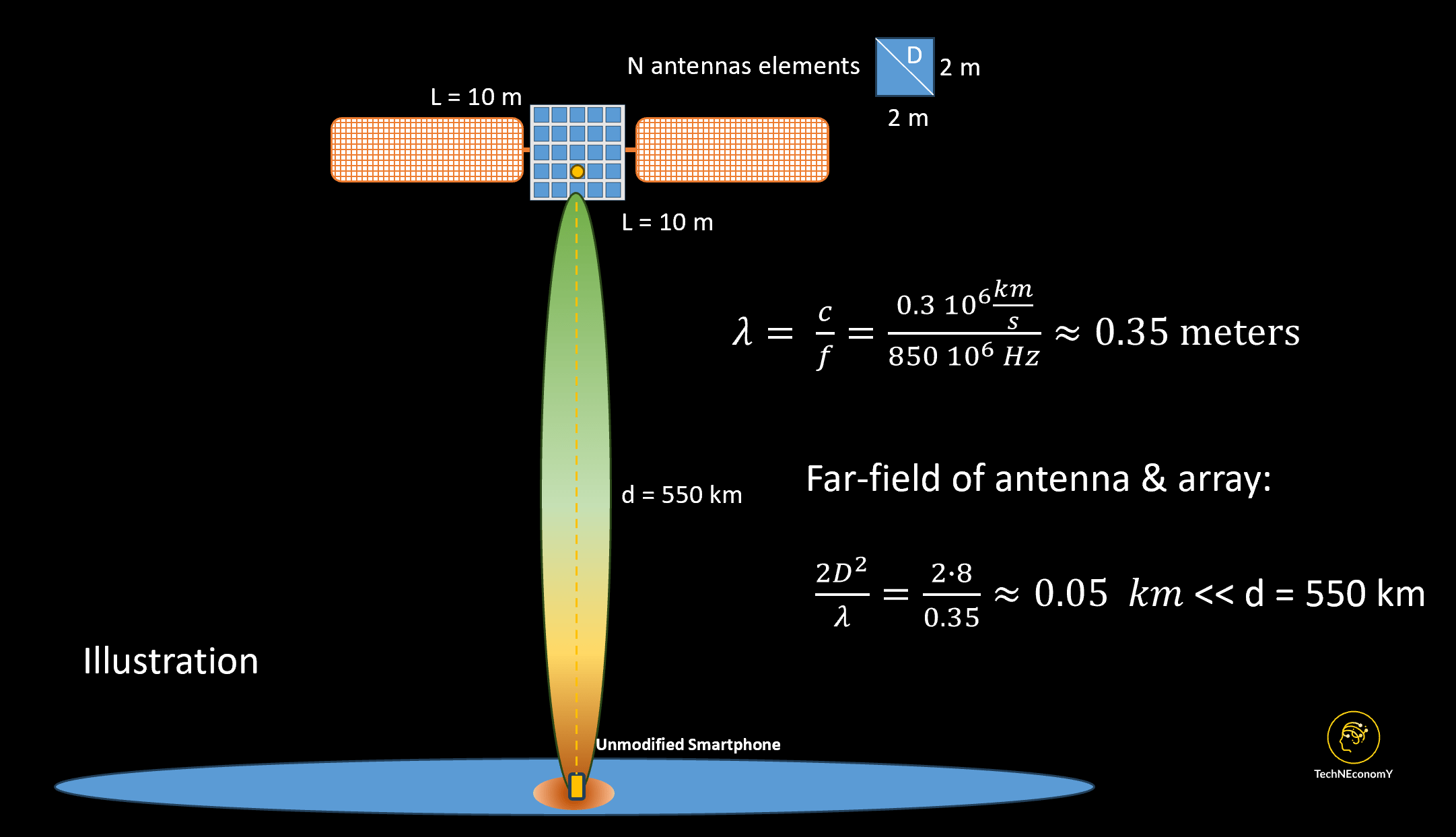
In order to deliver 500 Mbps per user with full indoor coverage, each downlink beam must sustain approximately 4.5 Gbps, accounting for spectral reuse and beam overlap. At an orbital altitude of 350 kilometers, downlink beams must remain narrow, typically covering no more than a 1-kilometer radius in urban zones, to match uplink geometry and maintain beam-level concurrency. The antenna gain required to meet these demands is in the range of 50 to 55 dBi, which the satellites achieve using high-frequency phased arrays with a physical aperture of approximately 100 to 200 m². Because the downlink system is responsible for high-power transmission, the antenna tiles incorporate GaN-based solid-state power amplifiers (SSPAs), which deliver hundreds of watts per panel. This results in an overall effective isotropic radiated power (EIRP) of 50 to 60 dBW per beam, sufficient to reach deep indoor devices even at the upper end of the C-band. The power-intensive nature of the downlink system introduces thermal management challenges (describe below in the next section), which are addressed by physically isolating the transmit arrays from the receiver surfaces. The downlink and uplink arrays are positioned on opposite sides of the spacecraft bus or thermally decoupled through deployable booms and shielding layers.

The downlink beamforming is fully digital, allowing real-time adaptation of beam patterns, power levels, and modulation schemes. Each satellite can form and manage up to 2,500 independent downlink beams, which are coordinated with their uplink counterparts to ensure tight spatial and temporal alignment. Advanced AI algorithms help shape beams based on environmental context, usage density, and user motion, thereby further improving indoor delivery performance. The modulation schemes used on the downlink frequently reach 256-QAM and beyond, with spectral efficiencies of six to eight bits per second per Hz in favorable conditions.

The physical deployment of the downlink antenna varies by platform, but most commonly consists of front-facing phased array panels or cylindrical surfaces fitted with azimuthally distributed tiles. These panels can be either fixed or mounted on articulated platforms that allow active directional steering during orbit, depending on the beam coverage strategy, an arrangement also called gumballed.

No Bars? Not on This Planet. In 2045, even the Icebears will have broadband. When satellites replaced cell towers, the Arctic became just another neighborhood in the global gigabit grid.

Satellite System Architecture.

The Direct-to-Cellular satellites have evolved into high-performance, orbital base stations that far surpass the capabilities of early systems, such as AST SpaceMobile’s Bluebird 1 or SpaceX’s Starlink V2 Mini. These satellites are engineered not merely to relay signals, but to deliver full-featured indoor mobile broadband connectivity directly to standard handheld devices, anywhere on Earth, including deep urban cores and rural regions that have been historically underserved by terrestrial infrastructure.

As described earlier, today’s D2C satellite supports up to 5,000 simultaneous beams, enabling real-time uplink and downlink with mobile users across a broad frequency range. The uplink phased array, designed to capture low-power, deep-indoor signals at 600 MHz, occupies approximately 750 m². The DL array, optimized for high-frequency, high-power transmission, spans 150 to 200 m². Unlike early designs, such as Bluebird 1, which used a single, large combined antenna, today’s satellites separate the uplink and downlink arrays to optimize each for performance, thermal behavior, and mechanical deployment. These two systems are typically mounted on opposite sides of the satellite and thermally isolated from one another.

Thermal management is one of the defining challenges of this architecture. While AST’s Bluebird 1 (i.e., from mid-2020s) boasted a large antenna aperture approaching 900 m², its internal systems generated significantly less heat. Bluebird 1 operated with a total power budget of approximately 10 to 12 kilowatts, primarily dedicated to a handful of downlink beams and limited onboard processing. In contrast, today’s D2C satellite requires a continuous power supply of 25 to 35 kilowatts, much of which must be dissipated as heat in orbit. This includes over 10 kilowatts of sustained RF power dissipation from the DL system alone, in addition to thermal loads from the digital beamforming hardware, AI-assisted compute stack, and onboard routing logic. The key difference lies in beam concurrency and onboard intelligence. The satellite manages thousands of simultaneous, high-throughput beams, each dynamically scheduled and modulated using advanced schemes such as 256-QAM and beyond. It must also process real-time uplink signals from cluttered environments, allocate spectral and spatial resources, and make AI-driven decisions about beam shape, handovers, and interference mitigation. All of this requires a compute infrastructure capable of delivering 100 to 500 TOPS (tera-operations per second), distributed across radiation-hardened processors, neural accelerators, and programmable FPGAs. Unlike AST’s Bluebird 1, which offloaded most of its protocol stack to the ground, today’s satellites run much of the 5G core network onboard. This includes RAN scheduling, UE mobility management, and segment-level routing for backhaul and gateway links.

This computational load compounds the satellite’s already intense thermal environment. Passive cooling alone is insufficient. To manage thermal flows, the spacecraft employs large radiator panels located on its outer shell, advanced phase-change materials embedded behind the DL tiles, and liquid loop systems that transfer heat from the RF and compute zones to the radiative surfaces. These thermal systems are intricately zoned and actively managed, preventing the heat from interfering with the sensitive UL receive chains, which require low-noise operation under tightly controlled thermal conditions. The DL and UL arrays are thermally decoupled not just to prevent crosstalk, but to maintain stable performance in opposite thermal regimes: one dominated by high-power transmission, the other by low-noise reception.

To meet its power demands, the satellite utilizes a deployable solar sail array that spans 60 to 80 m². These sails are fitted with ultra-high-efficiency solar cells capable of exceeding 30–35% efficiency. They are mounted on articulated booms that track the sun independently from the satellite’s Earth-facing orientation. They provide enough current to sustain continuous operation during daylight periods, while high-capacity batteries, likely based on lithium-sulfur or solid-state chemistry, handle nighttime and eclipse coverage. Compared to the Starlink V2 Mini, which generates around 2.5 to 3.0 kilowatts, and the Bluebird 1, which operates at roughly 10–12 kilowatts. Today’s system requires nearly three times the generation and five times the thermal rejection capability compared to the initial satellites of the mid-2020s.

Structurally, the satellite is designed to support this massive infrastructure. It uses a rigid truss core (i.e., lattice structure) with deployable wings for the DL system and a segmented, mesh-based backing for the UL aperture. Propulsion is provided by Hall-effect or ion thrusters, with 50 to 100 kilograms of inert propellant onboard to support three to five years of orbital station-keeping at an altitude of 350 kilometers. This height is chosen for its latency and spatial reuse advantages, but it also imposes continuous drag, requiring persistent thrust.

The AST Bluebird 1 may have appeared physically imposing in its time due to its large antenna, thermal, computational, and architectural complexity. Today’s D2C satellite, 20 years later, far exceeds anything imagined two decades earlier. The heat generated by its massive beam concurrency, onboard processing, and integrated network core makes its thermal management system not only more severe than Bluebird 1’s but also one of the primary limiting factors in the satellite’s physical and functional design. This thermal constraint, in turn, shapes the layout of its antennas, compute stack, power system, and propulsion.

Mass and Volume Scaling.

The AST’s Bluebird 1, launched in the mid-2020s, had a launch mass of approximately 1,500 kilograms. Its headline feature was a 900 m² unfoldable antenna surface, designed to support direct cellular connectivity from space. However, despite its impressive aperture, the system was constrained by limited beam concurrency, modest onboard computing power, and a reliance on terrestrial cores for most network functions. The bulk of its mass was dominated by structural elements supporting its large antenna surface and the power and thermal subsystems required to drive a relatively small number of simultaneous links. Bluebird’s propulsion was chemical, optimized for initial orbit raising and limited station-keeping, and its stowed volume fit comfortably within standard medium-lift payload fairings. Starlink’s V2 Mini, although smaller in physical aperture, featured a more balanced and compact architecture. Weighing roughly 800 kilograms at launch, it was designed around high-throughput broadband rather than direct-to-cellular use. Its phased array antenna surface was closer to 20–25 m², and it was optimized for efficient manufacturing and high-density orbital deployment. The V2 Mini’s volume was tightly packed, with solar panels, phased arrays, and propulsion modules folded into a relatively low-profile bus optimized for rapid deployment and low-cost launch stacking. Its onboard compute and thermal systems were scaled to match its more modest power budget, which typically hovered around 2.5 to 3.0 kilowatts.

In contrast, today’s satellites occupy an entirely new performance regime. The dry mass of the satellite ranges between 2,500 and 3,500 kilograms, depending on specific configuration, thermal shielding, and structural deployment method. This accounts for its large deployable arrays, high-density digital payload, radiator surfaces, power regulation units, and internal trusses. The wet mass, including onboard fuel reserves for at least 5 years of station-keeping at 350 km altitude, increases by up to 800 kilograms, depending on the propulsion type (e.g., Hall-effect or gridded ion thrusters) and orbital inclination. This brings the total launch mass to approximately 3,000 to 4,500 kilograms, or more than double ATS’s old Bluebird 1 and roughly five times that of SpaceX’s Starlink V2 Mini.

Volume-wise, the satellites require a significantly larger stowed configuration than either AST’s Bluebird 1 or SpaceX’s Starlink V2 Mini. While both of those earlier systems were designed to fit within traditional launch fairings, Bluebird 1 utilizes a folded hinge-based boom structure, and Starlink V2 Mini is optimized for ultra-compact stacking. Today’s satellite demands next-generation fairing geometries, such as 5-meter-class launchers or dual-stack configurations. This is driven by the dual-antenna architecture and radiator arrays, which, although cleverly folded during launch, expand dramatically once deployed in orbit. In its operational configuration, the satellite spans tens of meters across its antenna booms and solar sails. The uplink array, built as a lightweight, mesh-backed surface supported by rigidizing frames or telescoping booms, unfolds to a diameter of approximately 30 to 35 meters, substantially larger than Bluebird 1’s ~20–25 meter maximum span and far beyond the roughly 10-meter unfolded span of Starlink V2 Mini. The downlink panels, although smaller, are arranged for precise gimballed orientation (i.e., a pivoting mechanism allowing rotation or tilt along one or more axes) and integrated thermal control, which further expands the total deployed volume envelope. The volumetric footprint of today’s D2C satellite is not only larger in surface area but also more spatially complex, as its segregated UL and DL arrays, thermal zones, and solar wings must avoid interference while maintaining structural and thermal equilibrium. Compared to the simplified flat-pack layout of Starlink V2 Mini and the monolithic boom-deployed design of Bluebird 1.

The increase in dry mass, wet mass, and deployed volume is not a byproduct of inefficiency, but a direct result of very substantial performance improvements that were required to replace terrestrial mobile towers with orbital systems. Today’s D2C satellites deliver an order of magnitude more beam concurrency, spectral efficiency, and per-user performance than its 2020s predecessors. This is reflected in every subsystem, from power generation and antenna design to propulsion, thermal control, and computing. As such, it represents the emergence of a new class of satellite altogether: not merely a space-based relay or broadband node, but a full-featured, cloud-integrated orbital RAN platform capable of supporting the global cellular fabric from space.

CAN THE FICTION BECOME A REALITY?

From the perspective of 2025, the vision of a global satellite-based mobile network providing seamless, unmodified indoor connectivity at terrestrial-grade uplink and downlink rates, 50 Mbps up, 500 Mbps down, appears extraordinarily ambitious. The technical description from 2045 outlines a constellation of 20,800 LEO satellites, each capable of supporting 5,000 independent full-duplex beams across massive bandwidths, while integrating onboard processing, AI-driven beam control, and a full 5G core stack. To reach such a mature architecture within two decades demands breakthrough progress across multiple fronts.

The most daunting challenge lies in achieving indoor-grade cellular uplink at frequencies as low as 600 MHz from devices never intended to communicate with satellites. Today, even powerful ground-based towers struggle to achieve sub-1 GHz uplink coverage inside urban buildings. For satellites at an altitude of 350 km, the free-space path loss alone at 600 MHz is approximately 133 dB. When combined with clutter, penetration, and polarization mismatches, the system must close a link budget approaching 153–160 dB, from a smartphone transmitting just 23 dBm (200 mW) or less. No satellite today, including AST SpaceMobile’s BlueBird 1, has demonstrated indoor uplink reception at this scale or consistency. To overcome this, the proposed system assumes deployable uplink arrays of 750 m² with gain levels exceeding 45 dBi, supported by hundreds of simultaneously steerable receive beams and ultra-low-noise front-end receivers. From a 2025 lens, the mechanical deployment of such arrays, their thermal stability, calibration, and mass management pose nontrivial risks. Today’s large phased arrays are still in their infancy in space, and adaptive beam tracking from fast-moving LEO platforms remains unproven at the required scale and beam density.

Thermal constraints are also vastly more complex than anything currently deployed. Supporting 5,000 simultaneous beams and radiating tens of kilowatts from compact platforms in LEO requires heat rejection systems that go beyond current radiator technology. Passive radiators must be supplemented with phase-change materials, active fluid loops, and zoned thermal isolation to prevent transmit arrays from degrading the performance of sensitive uplink receivers. This represents a significant leap from today’s satellites, such as Starlink V2 Mini (~3 kW) or BlueBird 1 (~10–12 kW), neither of which operates with a comparable beam count, throughput, or antenna scale.

The required onboard compute is another monumental leap. Running thousands of simultaneous digital beams, performing real-time adaptive beamforming, spectrum assignment, HARQ scheduling, and AI-driven interference mitigation, all on-orbit and without ground-side offloading, demands 100–500 TOPS of radiation-hardened compute. This is far beyond anything that will be flying in 2025. Even state-of-the-art military systems rely heavily on ground computing and centralized control. The 2045 vision implies on-orbit autonomy, local decision-making, and embedded 5G/6G core functionality within each spacecraft, a full software-defined network node in orbit. Realizing such a capability requires not only next-gen processors but also significant progress in space-grade AI inference, thermal packaging, and fault tolerance.

On the power front, generating 25–35 kW per satellite in LEO using 60–80 m² solar sails pushes the boundary of photovoltaic technology and array mechanics. High-efficiency solar cells must achieve conversion rates exceeding 30–35%, while battery systems must maintain high discharge capacity even in complete darkness. Space-based power architectures today are not yet built for this level of sustained output and thermal dissipation.

Even if the individual satellite challenges are solved, the constellation architecture presents another towering hurdle. Achieving seamless beam handover, full spatial reuse, and maintaining beam density over demand centers as the Earth rotates demands near-perfect coordination of tens of thousands of satellites across hundreds of planes. No current LEO operator (including SpaceX) manages a constellation of that complexity, beam concurrency, or spatial density. Furthermore, scaling the manufacturing, testing, launch, and in-orbit commissioning of over 20,000 high-performance satellites will require significant cost reductions, increased factory throughput, and new levels of autonomous deployment.

Regulatory and spectrum allocation are equally formidable barriers. The vision entails the massively complex undertaking of a global reallocation of terrestrial mobile spectrum, particularly in the sub-3 GHz bands, to LEO operators. As of 2025, such a reallocation is politically and commercially fraught, with entrenched mobile operators and national regulators unlikely to cede prime bands without extensive negotiation, incentives, and global coordination. The use of 600–1800 MHz from orbit for direct-to-device is not yet globally harmonized (and may never be), and existing terrestrial rights would need to be either vacated or managed via complex sharing schemes.

From a market perspective, widespread device compatibility without modification implies that standard mobile chipsets, RF chains, and antennas evolve to handle Doppler compensation, extended RTT timing budgets, and tighter synchronization tolerances. While this is not insurmountable, it requires updates to 3GPP standards, baseband silicon, and potentially network registration logic, all of which must be implemented without degrading terrestrial service. Although NTN (non-terrestrial networks) support has begun to emerge in 5G standards, the level of transparency and ubiquity envisioned in 2045 is not yet backed by practical deployments.

While the 2045 architecture described so far assumes a single unified constellation delivering seamless global cellular service from orbit, the political and commercial realities of space infrastructure in 2025 strongly suggest a fragmented outcome. It is unlikely that a single actor, public or private, will be permitted, let alone able, to monopolize the global D2C landscape. Instead, the most plausible trajectory is a competitive and geopolitically segmented orbital environment, with at least one major constellation originating from China (note: I think it is quit likely we may see two major ones), another from the United States, a possible second US-based entrant, and potentially a European-led system aimed at securing sovereign connectivity across the continent. This fracturing of the orbital mobile landscape imposes a profound constraint on the economic and technical scalability of the system. The assumption that a single constellation could achieve massive economies of scale, producing, launching, and managing tens of thousands of high-performance satellites with uniform coverage obligations, begins to collapse under the weight of geopolitical segmentation. Each competitor must now shoulder its own development, manufacturing, and deployment costs, with limited ability to amortize those investments over a unified global user base. Moreover, such duplication of infrastructure risks saturating orbital slots and spectrum allocations, while reducing the density advantage that a unified system would otherwise enjoy. Instead of concentrating thousands of active beams over a demand zone with a single coordinated fleet, separate constellations must compete for orbital visibility and spectral access over the same urban centers. The result is likely to be a decline in per-satellite utilization efficiency, particularly in regions of geopolitical overlap or contested regulatory coordination.

2045: One Vision, Many Launch Pads. The dream of global satellite-to-cellular service may shine bright, but it won’t rise from a single constellation. With China, the U.S., and others racing skyward, the economics of universal LEO coverage could fracture into geopolitical silos, making scale, spectrum, and sustainability more contested than ever.

Finally, the commercial viability of any one constellation diminishes when the global scale is eroded. While a monopoly or globally dominant operator could achieve lower per-unit satellite costs, higher average utilization, and broader roaming revenues, a fractured environment reduces ARPU (average revenue per user). It increases the breakeven threshold for each deployment. Satellite throughput that could have been centrally optimized now risks duplication and redundancy, increasing operational overhead and potentially slowing innovation as vendors attempt to differentiate on proprietary terms. In this light, the architecture described earlier must be seen as an idealized vision. This convergence point may never be achieved in pure form unless global policy, spectrum governance, and commercial alliances move toward more integrated outcomes. While the technological challenges of the 2045 D2C system are significant, the fragmentation of market structure and geopolitical alignment may prove an equally formidable barrier to realizing the full systemic potential. While a monopoly or globally dominant operator could achieve lower per-unit satellite costs, higher average utilization, and broader roaming revenues, a fractured environment reduces ARPU (average revenue per user). It increases the breakeven threshold for each deployment. Satellite throughput that could have been centrally optimized now risks duplication and redundancy, increasing operational overhead and potentially slowing innovation as vendors attempt to differentiate on proprietary terms. In this light, the architecture described earlier must be seen as an idealized vision. This convergence point may never be achieved in pure form unless global policy, spectrum governance, and commercial alliances move toward more integrated outcomes. While the technological challenges of the 2045 D2C system are significant, the fragmentation of market structure and geopolitical alignment may prove an equally formidable barrier to realizing the full systemic potential.

Heavenly Coverage, Hellish Congestion. Even a single mega-constellation turns the sky into premium orbital real estate … and that’s before the neighbors show up with their own fleets. Welcome to the era of broadband traffic … in space.

Despite these barriers, incremental paths forward exist. Demonstration satellites in the late 2020s, followed by regional commercial deployments in the early 2030s, could provide real-world validation. The phased evolution of spectrum use, dual-use handsets, and AI-assisted beam management may mitigate some of the scaling concerns. Regulatory alignment may emerge as rural and unserved regions increasingly depend on space-based access. Ultimately, the achievement of the 2045 architecture relies not only on engineering but also on sustained cross-industry coordination, geopolitical alignment, and commercial viability on a planetary scale. As of 2025, the probability of realizing the complete vision by 2045, in terms of indoor-grade, direct-to-device service via a fully orbital mobile core, is perhaps 40–50%, with a higher probability (~70%) for achieving outdoor-grade or partially integrated hybrid services. The coming decade will reveal whether the industry can fully solve the unique combination of thermal, RF, computational, regulatory, and manufacturing challenges required to replace the terrestrial mobile network with orbital infrastructure.

POSTSCRIPT – THE ECONOMICS.

The Direct-to-Cellular satellite architecture described in this article would reshape not only the technical landscape of mobile communications but also its economic foundation. The very premise of delivering mobile broadband directly from space, bypassing terrestrial towers, fiber backhaul, and urban permitting, undermines one of the most entrenched capital systems of the 20th and early 21st centuries: the mobile infrastructure economy. Once considered irreplaceable, the sprawling ecosystem of rooftop leases, steel towers, field operations, base stations, and fiber rings has been gradually rendered obsolete by a network that floats above geography.

The financial implications of such a shift are enormous. Before such an orbital transition described in this article, the global mobile industry invested well over 300 billion USD annually in network CapEx and Opex, with a large share dedicated to the site infrastructure layer, construction, leasing, energy, security, and upkeep of millions of base stations and their associated land or rooftop assets. Tower companies alone have become multi-billion-dollar REITs (i.e., Real Estate Investment Trusts), profiting from site tenancy and long-term operating contracts. As of the mid-2020s, the global value tied up in the telecom industry’s physical infrastructure is estimated to exceed 2.5 to 3 trillion USD, with tower companies like Cellnex and American Tower collectively managing hundreds of billions of dollars in infrastructure assets. An estimated $300–500 billion USD invested in mobile infrastructure represents approximately 0.75% to 1.5% of total global pension assets and accounts for 15% to 30% of pension fund infrastructure investments. This real estate-based infrastructure model defined mobile economics for decades and has generally been regarded as a reasonably safe haven for investors. In contrast, the 2045 D2C model front-loads its capital burden into satellite manufacturing, launch, and orbital operations. Rather than being geographically bound, capital is concentrated into a fleet of orbital base stations, each capable of dynamically serving users across vast and shifting geographies. This not only eliminates the need for millions of distributed cell sites, but it also breaks the historical tie between infrastructure deployment and national geography. Coverage no longer scales with trenching crews or urban permitting delays but with orbital plane density and beamforming algorithms.

Yet, such a shift does not necessarily mean lower cost, only different economics. Launching and operating tens of thousands of advanced satellites, each capable of supporting thousands of beams and running onboard compute environments, still requires massive capital outlay and ongoing expenditures in space traffic management, spectrum coordination, ground gateways, and constellation replenishment. The difference lies in utilization and marginal reach. Where terrestrial infrastructure often struggles to achieve ROI in rural or low-income markets, orbital systems serve these zones as part of the same beam budget, with no new towers or trenches required.

Importantly, the 2045 model would likely collapse the mobile value chain. Instead of a multi-layered system of operators, tower owners, fiber wholesalers, and regional contractors, a vertically integrated satellite operator can now deliver the full stack of mobile service from orbit, owning the user relationship end-to-end. This disintermediation has significant implications for revenue distribution and regulatory control, and challenges legacy operators to either adapt or exit.

The scale of economic disruption mirrors the scale of technical ambition. This transformation could rewrite the very economics of connectivity. While the promise of seamless global coverage, zero tower density, and instant-on mobility is compelling, it may also signal the end of mobile telecom as a land-based utility.

If this little science fiction story comes true, and there are many good and bad reasons to doubt it, Telcos may not Ascend to the Sky, but take the Stairway to Heaven.

Graveyard of the Tower Titans. This symbolic illustration captures the end of an era, depicting headstones for legacy telecom giants such as American Tower, Crown Castle, and SBA Communications, as well as the broader REIT (Real Estate Investment Trust) infrastructure model that once underpinned the terrestrial mobile network economy. It serves as a metaphor for the systemic shift brought on by Direct-to-Cellular (D2C) satellite networks. What’s fading is not only the mobile tower itself, but also the vast ancillary industry that has grown around it, including power systems, access rights, fiber-infrastructure, maintenance firms, and leasing intermediaries, as well as the telecom business model that relied on physical, ground-based infrastructure. As the skies take over the signal path, the economic pillars of the old telecom world may no longer stand.

FURTHER READING.

Kim K. Larsen, “Will LEO Satellite Direct-to-Cellular Networks Make Traditional Mobile Networks Obsolete?”, A John Strand Consult Report, (January 2025). This has also been published in full on my own Techneconomyblog.

Kim K. Larsen, “Can LEO Satellites close the Gigabit Gap of Europe’s Unconnectables?“ Techneconomyblog (April 2025).

Kim K. Larsen, “The Next Frontier: LEO Satellites for Internet Services.” Techneconomyblog (March 2024).

Kim K. Larsen, “Stratospheric Drones & Low Earth Satellites: Revolutionizing Terrestrial Rural Broadband from the Skies?” Techneconomyblog (January 2024).

Kim K. Larsen, “A Single Network Future“, Techneconomyblog (March 2024).

ACKNOWLEDGEMENT.

I would like to acknowledge my wife, Eva Varadi, for her unwavering support, patience, and understanding throughout the creative process of writing this article.

A Single Network Future.

How to think about a single network future? What does it entail, and what is it good for?

Well, imagine a world where your mobile device, unchanged and unmodified, connects to the nearest cell tower and satellites orbiting Earth, ensuring customers will always be best connected, getting the best service, irrespective of where they are. Satellite-based supplementary coverage (from space) seeks to deliver on this vision by leveraging superior economic coverage in terms of larger footprint (than feasible with terrestrial networks) and better latency (compared to geostationary satellite solutions) to bring connectivity directly to unmodified consumer handsets (e.g., smartphone, tablet, IoT devices), enhance emergency communication, and foster advancements in space-based technologies. The single network future does not only require certain technological developments, such as 3GPP Non-Terrestrial Network standardization efforts (e.g., Release 17 and forward). We also need the regulatory spectrum policy to change, allowing today’s terrestrially- and regulatory-bounded cellular frequency spectra to be re-used by satellite operators providing the same mobile service under satellite coverage in areas without terrestrial communications infrastructure, as mobile customers enjoy within the normal terrestrial cellular network.

It is estimated that less than 40% of the world’s population, or roughly 2.9 billion people, have never used the internet (as of 2023). That 60% of the world population have access to internet and 40% have not, is the digital divide. A massive gap most pronounced in developing countries, rural & remote areas, and among older populations and economically disadvantaged groups. Most of the 2.9 billion on the wrong side of the divide live in areas lacking terrestrial-based technology infrastructure that would readily facilitate access to the internet. It lacks the communications infrastructure because it may either be impractical or (and) un-economical to deploy, including difficulty in monetizing and yielding a positive return on investment over a relatively short period. Satellites that are allowed by regulatory means to re-use terrestrially-based cellular spectrum for supplementary (to terrestrial) coverage can largely solve the digital divide challenges (as long as affordable mobile devices and services are available to the unconnected).

This blog explores some of the details of the, in my opinion, forward-thinking FCC’s Supplementary Coverage from Space (SCS) framework and vision of a Single Network in which mobile cellular communication is not limited to tera firma but supplemented and enhanced by satellites, ensuring connectivity everywhere.

SUPPLEMENTARY COVERAGE FROM SPACE.

Federal Communications Commission (FCC) recently published a new regulatory framework (“Report & Order and further notice of proposed rulemaking“) designed to facilitate the integration of satellite and terrestrial networks to provide Supplemental Coverage from Space (SCS), marking a significant development toward achieving ubiquitous connectivity. In the following, I will use the terms “SCS framework” and ” SCS initiative” to cover the reference to the FCC’s regulatory framework. The SCS initiative, which, to my knowledge, is the first of its kind globally, aims to allow satellite operators and terrestrial service providers to collaborate, leveraging the spectrum previously allocated exclusively for terrestrial services to extend connectivity directly to consumer handsets, what is called satellite direct-to-device (D2D), especially in remote, unserved, and underserved areas. The proposal is expected to enhance emergency communication availability, foster advancements in space-based technologies, and promote the innovative and efficient use of spectrum resources.

The “Report and Order” formalizes a spectrum-use framework, adopting a secondary mobile-satellite service (MSS) allocation in specific frequency bands devoid of primary non-flexible-use legacy incumbents, both federal and non-federal. Let us break this down in a bit more informal language. So, the FCC proposes to designate certain parts of the radio frequency spectrum (see below) for mobile-satellite services on a “secondary” basis. In spectrum management, an allocation is deemed “secondary” when it allows for the operation of a service without causing interference to the “primary” services in the same band. This means that the supplementary satellite service, deemed secondary, must accept interference from primary services without claiming protection. Moreover, this only applies to locations that lack (i.e., devoid of) the use of a given frequency band by existing ” primary” spectrum users (i.e., incumbents), non-federal as well as federal primary uses.

The setup encourages collaboration and permits supplemental coverage from space (SCS) in designated bands where terrestrial licensees, holding all licenses for a channel throughout a geographically independent area (GIA), lease access to their terrestrial spectrum rights to a satellite operator. Furthermore, the framework establishes entry criteria for satellite operators to apply for or modify an existing “part 25” space station license for SCS operations, that is the regulatory requirements established by the FCC governing the licensing and operation of satellite communications in the United States. The framework also outlines a licensing-by-rule approach for terrestrial devices acting as SCS earth stations, referring to a regulatory and technological framework where conventional consumer devices, such as smartphones or tablets, are equipped to communicate directly with satellites (after all we do talk about Direct-2-Device).

The above picture showcases a moment in the remote Arizona desert where an individual receives a direct signal to the device from a Low-Earth Orbit (LEO) satellite to his or her smartphone. The remote area has no terrestrial cellular coverage, and supplementary coverage from space is the only way for individuals with a subscription to access their cellular services or make a distress call apart from using a costly satellite phone service. It should be remembered that the SCS service is likely to be capacity-limited due to the typical large satellite coverage area and possible limited available SCS spectrum bandwidth.

Additionally, the Further Notice of Proposed Rulemaking seeks further commentary on aspects such as 911 service provision and the protection of radio astronomy, indicating the FCC’s consistent commitment to refining and expanding the SCS framework responsibly. This commitment ensures that the framework will continue to evolve, adapting to new challenges and opportunities and providing a solid foundation for future developments.

BALANCING THE AIRWAVES IN THE USA.

Two agencies in the US manage the frequency spectrum, the Federal Communications Commission (FCC) and the National Telecommunications and Information Administration (NTIA) . They collaboratively manage and coordinate frequency spectrum use and reuse for satellites, among other applications, within the United States. This partnership is important for maintaining a balanced approach to spectrum management that supports federal and non-federal needs, ensuring that satellite communications and other services can operate effectively without causing harmful interference to each other.

The Federal Communications Commission, the FCC for short, is an independent agency that exclusively regulates all non-Federal spectrum use across the United States. FCC allocates spectrum licenses for commercial use, typically through spectrum auctions. A new or re-purposed commercialized spectrum has been reclaimed from other uses, both from federal uses and existing commercial uses. Spectrum can be re-purposed either because newer, more spectrally efficient technologies become available (e.g., the transition from analog to digital broadcasting) or it becomes viable to shift operation to other spectrum bands with less commercial value (and, of course, without jeopardizing existing operational excellence). It is also possible that spectrum, previously having been for exclusive federal use (e.g., military applications, fixed satellite uses, etc.), can be shared, such as the case with Citizens Broadband Radio Service (CBRS), which allows non-federal parties access to 150 MHz in the 3.5 GHz band (i.e., band 48). However, it has recently been concluded that (centralized) dynamic spectrum sharing only works in certain use cases and is associated with considerable implementation complexities. Multiple parties with possible vastly different requirements co-exist within a given band, which is a work in progress and may not be consistent with the commercialized spectrum operation required for high-quality broadband cellular operation.

Alongside the FCC, the National Telecommunications and Information Administration (NTIA) plays a crucial role in US spectrum management. The NTIA is the sole authority responsible for authorizing Federal spectrum use. It also serves as the principal adviser on telecommunications policies to the President of the United States, coordinating the views of the Executive Branch. The NTIA manages a significant portion of the spectrum, approximately 2,398 MHz (69%), within the range of 225 MHz to 3.7 GHz, known as the ‘beachfront spectrum’. Of the total 3,475 MHz, 591 MHz (17%) is exclusively for Federal use, and 1,807 MHz (52%) is shared or coordinated between Federal and non-Federal entities. This leaves 1,077 MHz (31%) for exclusive commercial use, which falls under the management of the FCC.

NTIA, in collaboration with the FCC, has been instrumental in the past in freeing up substantial C-band spectrum, 480 MHz in total, of which 100 MHz is conditioned on prioritized sharing (i.e., Auction 105), for commercial and shared use that subsequently has been auctioned off over the last three years raising USD 109 billion. In US Dollar (USD) per MHz per population count (pop), we have, on average, ca. USD 0.68 per MHz-pop from the C-band auctions in the US, compared to USD 0.13 per MHz-pop in Europe C-band auctions and USD 0.23 per MHz-pop in APAC auctions. It should be remembered that the United States exclusive-use spectrum licenses can be regarded as an indefinite-lived intangible asset, while European spectrum rights expire between 10 and 20 years. This may explain a big part of the difference between US-based spectrum pricing and Europe and Asia.

The FCC and the NTIA jointly manage all the radio spectrum in the United States, licensed (e.g., cellular mobile frequencies, TV signals) and unlicensed (e.g., WiFi, MW Owens). The NTIA oversees spectrum use for Federal purposes, while the FCC is responsible for non-Federal use. In addition to its role in auctioning spectrum licenses, the FCC is also authorized to redistribute licenses. This authority allows the FCC to play a vital role in ensuring efficient spectrum use and adapting to changing needs.

THE SINGLE NETWORK.

The Supplementary Coverage from Space (SCS) framework creates an enabling regulatory framework for satellite operators to provide mobile broadband services to unmodified mobile devices (i.e., D2D services), such as smartphones and other terrestrial cellular devices, in rural and remote areas without such services, where no or only scarce terrestrial infrastructure exists. By leveraging SCS, terrestrial cellular broadband services will be enhanced, and the combination may result in a unified network. This network will ensure continuous and ubiquitous access to communication services, overcoming geographical and environmental challenges. Thus, this led to the inception of the Single Network that can provide seamless connectivity across diverse environments, including remote, unserved, and underserved areas.

The above picture illustrates the idea behind the FCC’s SCS framework and “Single Network” on a high level. In this example, an LEO satellite provides direct-to-device (D2D) supplementary coverage in rural and remote areas, using an advanced phase-array antenna, to unmodified user equipment (e.g., smartphone, tablet, cellular-IoT, …) in the same frequency band (i.e., f1,sat) owned and used by a terrestrial operator operating a cellular network (f1). The LEO satellite operator must partner with the terrestrial spectrum owner to manage and coordinate the frequency re-use in areas where the frequency owner (i.e., mobile/cellular operator) does not have the terrestrial-based infrastructure to deliver a service to its customers (i.e., typically remote, rural areas where terrestrial infrastructure is impractical and uneconomic to deploy). The satellite operator has to avoid geographical regions where the frequency (e.g., f1) is used by the spectrum owner, typically in urban, suburban, and rural areas (where terrestrial cellular infrastructure has already been deployed and service offered).

How does the “Single Network” of FCC differ from the 3GPP Non-Terrestrial Network (NTN) standardization? Simply put, the “Single Network” is a regulatory framework that paves the way for satellite operators to re-use the terrestrial cellular spectrum on their non-terrestrial (satellite-based) network. The 3GPP NTN standardization initiatives, e.g., Release 16, 17 and 18+, are a technical effort to incorporate satellite communication systems within the 5G network architecture. Shortly, the following 3GPP releases are it relates to how NTN should function with terrestrial 5G networks;

  • Release 15 laid the groundwork for 5G New Radio (NR) and started to consider the broader picture of integrating non-terrestrial networks with terrestrial 5G networks. It marks the beginning of discussions on how to accommodate NTNs within the 5G framework, focusing on study items rather than specific NTN standards.
  • Release 16 took significant steps toward defining NTN by including study items and work items specifically aimed at understanding and specifying the adjustments needed for NR to support communication with devices served by NTNs. Release 16 focuses on identifying modifications to the NR protocol and architecture to accommodate the unique characteristics of satellite communication, such as higher latency and different mobility characteristics compared to terrestrial networks.
  • Release 17 further advancements in NTN specifications aiming to integrate specific technical solutions and standards for NTNs within the 5G architecture. This effort includes detailed specifications for supporting direct connectivity between 5G devices and satellites, covering aspects like signal timing, frequency bands, and protocol adaptations to handle the distinct challenges posed by satellite communication, such as the Doppler effect and signal delay.
  • Release 18 and beyond will continue to evolve its standards to enhance NTN support, addressing emerging requirements and incorporating feedback from early implementations. These efforts include refining and expanding NTN capabilities to support a broader range of applications and services, improving integration with terrestrial networks, and enhancing performance and reliability.

The NTN architecture ensures (should ensure) that satellite communications systems can seamlessly integrate into 5G networks, supporting direct communication between satellites and standard mobile devices. This integration idea includes adapting 5G protocols and technologies to accommodate the unique characteristics of satellite communication, such as higher latency and different signal propagation conditions. The NTN standardization aims to expand the reach of 5G services to global scales, including maritime, aerial, and sparsely populated land areas, thereby aligning with the broader goal of universal service coverage.

The FCC’s vision of a “single network” and the 3GPP NTN standardization aims to integrate satellite and terrestrial networks to extend connectivity, albeit from slightly different angles. The FCC’s concept provides a regulatory and policy framework to enable such integration across different network types and service providers, focusing on the broad goal of universal connectivity. In contrast, 3GPP’s NTN standardization provides the technical specifications and protocols to make this integration possible, particularly within next-generation (5G) networks. At the same time, 3GPP’s NTN efforts address the technical underpinnings required to realize that vision in practice, especially for 5G technologies. The FCC’s “single network” concept lays the regulatory foundation for enabling satellite and terrestrial cellular network service integration to the same unmodified device portfolio. Together, they are highly synergistic, addressing the regulatory and technical challenges of creating a seamlessly connected world.

Depicting a moment in the Colorado mountains, a hiker receives a direct signal from a Low Earth Orbit (LEO) satellite supplementary coverage to their (unmodified) smartphone. The remote area has no terrestrial cellular coverage. It should be remembered that the SCS service is likely to be capacity-limited due to the typical large satellite coverage area and possible limited available SCS spectrum bandwidth.

SINGLE NETWORK VS SATELLITE ATC

The FCC’s Single Network vision and the Supplemental Coverage from Space (SCS) concept, akin to the Satellite Ancillary Terrestrial Component (ATC) architectural concept (an area that I spend a significant portion of my career working on operationalizing and then defending … a different story though), share a common goal of merging satellite and terrestrial networks to fortify connectivity. These strategies, driven by the desire to enhance the reach and reliability of communication services, particularly in underserved regions, hold the promise of expanded service coverage.

The Single Network and SCS initiatives broadly focus on comprehensively integrating satellite services with terrestrial infrastructures, aiming to directly connect satellite systems with standard consumer devices across various services and frequency bands. This expansive approach seeks to ensure ubiquitous connectivity, significantly closing the coverage gaps in current network deployments. Conversely, the Satellite ATC concept is more narrowly tailored, concentrating on using terrestrial base stations to complement and enhance satellite mobile services. This method explicitly addresses the need for improved signal availability and service reliability in urban or obstructed areas by integrating terrestrial components within the satellite network framework.

Although the Single Network and Satellite ATC shared goals, the paths to achieving them diverge significantly in the application, regulatory considerations, and technical execution. The SCS concept, for instance, involves navigating regulatory challenges associated with direct-to-device satellite communications, including the complexities of spectrum sharing and ensuring the harmonious coexistence of satellite and terrestrial services. This highlights the intricate nature of network integration, making your audience more aware of the regulatory and technical hurdles in this field.

The distinction between the two concepts lies in their technological and implementation specifics, regulatory backdrop, and focus areas. While both aim to weave together the strengths of satellite and terrestrial technologies, the Single Network and SCS framework envisions a more holistic integration of connectivity solutions, contrasting with the ATC’s targeted approach to augmenting satellite services with terrestrial network support. This illustrates the evolving landscape of communication networks, where the convergence of diverse technologies opens new avenues for achieving seamless and widespread connectivity.

THE RELATED SCS FREQUENCIES & SPECTRUM.

The following frequency bands and the total bandwidth associated with the frequency have by the FCC been designated for Supplemental Coverage from Space (SCS):

  • 70MHz @ 600 MHz Band
  • 96 MHz @ 700 MHz Band
  • 50 MHz @ 800 MHz Band
  • 130 MHz @ Broadband PCS
  • 10 MHz @ AWS-H Block

The above comprises a total frequency bandwidth of 350+ MHz, currently used for terrestrial cellular services across the USA. According to the FCC, the above frequency bands and spectrum can also be used for satellite direct-to-device SCS services to normal mobile devices without built-in satellite transceiver functionality. Of course, this is subject to spectrum owners’ approval and contractual and commercial arrangements.

Moreover, the 758-769/788-799 MHz band, licensed to the First Responder Network Authority (FirstNet), is also eligible for SCS under the established framework. This frequency band has been selected to enhance connectivity in remote, unserved, and underserved areas by facilitating collaborations between satellite and terrestrial networks within these specific frequency ranges.

SpaceX recently reported a peak download speed of 17 Mb/s from a satellite direct to an unmodified Samsung Android Phone using 2×5 MHz of T-Mobile USA’s PCS (i.e., the G-block). The speed corresponds to a downlink spectral efficiency of ~3.4 Mbps/MHz/beam, which is pretty impressive. Using this as rough guidance for the ~350 MHz, we should expect this to be equivalent to an approximate download speed of ca. 600 Mbps (@ 175 MHz) per satellite beam. As the satellite antenna technology improves, we should expect that spectral efficiency will also increase, resulting in increasing downlink throughput.

SCS INFANCY, BUT ALIVE AND KICKING.

In the FCC’s framework on the Supplemental Coverage from Space (SCS), the partnership between SpaceX and T-Mobile is described as a collaborative effort where SpaceX would utilize a block of T-Mobile’s mid-band Personal Communications Services (PCS G-Block) spectrum across a nationwide footprint. This initiative aims to provide service to T-Mobile’s subscribers in rural and remote locations, thereby addressing coverage gaps in T-Mobile’s terrestrial network. The FCC has facilitated this collaboration by allowing SpaceX and T-Mobile to deploy and test their proposed SCS system while their pending applications and the FCC’s proceedings continue.

Specifically, SpaceX has been authorized (by FCC’s Space Bureau) to deploy a modified version of its second-generation (2nd generation) Starlink satellites with SCS-capable antennas that can operate in specific frequencies. FCC authorized experimental testing on terrestrial locations for SpaceX and T-Mobile to progress with their SCS system, although SpaceX’s requests for broader authority remain under consideration by the FCC.

Lynk Global has partnered with mobile network operators (MNOs) outside the United States to allow the MNOs’ customers to send texts using Lynk’s satellite network. In 2022, the FCC authorized Lynk’s request to operate a non-geostationary satellite orbit (NGSO) satellite system (e.g., Low-Earth Orbit, Medium Earth Orbit, or Highly-Elliptical Orbit) intended for text message communications in locations outside the United States and in countries where Lynk has obtained agreements with MNOs and the required local regulatory approval. Lynk aims to deploy ten mobile-satellite service (MSS) satellites as part of a “cellular-based satellite communications network” operating on cellular frequencies globally in the 617-960 MHz band (i.e., within the UHF band), targeting international markets only.

Lynk has announced contracts with more than 30 MNOs (full list not published) covering over 50 countries for Lynk’s “satellite-direct-to-standard-mobile-phone-system,” which provides emergency alerts and two-way Short Message Service (SMS) messaging. Lynk currently has three LEO satellites in orbit as of March 2023, and they plan to expand their constellation to include up to 5,000 satellites with 50 additional satellites planned for end of 2024, and with that substantially broadening its geographic coverage and service capabilities​​. Lynk recently claimed that they had in Hawaii achieved repeated successful downlink speeds above 10 Mbps with several mass market unmodified smartphones (10+ Mbps indicates a spectral efficiency of 2+ Mbps/MHz/beam). Lynk Mobile has also, recently (July 2023) demonstrated (as a proof of concept) phone calls via their LEO satellite between two unmodified smartphones (see the YouTube link).

AST SpaceMobile is also mentioned for its partnerships with several MNOs, including AT&T and Vodafone, to develop its direct-to-device or satellite-to-smartphone service. Overall AST SpaceMobile has announced it has entered into “more than 40 agreements and understandings with mobile network operators globally” (e.g., AT&T, Vodafone, Rakuten, Orange, Telefonica, TIM, MTN, Ooredoo, …). In 2020, AST filed applications with the FCC seeking U.S. market access for gateway links in the V-band for its SpaceMobile satellite system, which is planned to consist of 243 LEO satellites. AST clarified that its operation in the United States would collaborate with terrestrial licensee partners without seeking to operate independently on terrestrial frequencies​​.

AST SpaceMobile BlueWalker 3 (BW3) LEO satellite 64 square-meter phased array. Source: AST SpaceMobile.

AST SpaceMobile’s satellite antenna design marks a pioneering step in satellite communications. AST recently deployed the largest commercial phased array antenna into Low Earth Orbit (LEO). On September 10, 2022, AST SpaceMobile launched its prototype direct-to-device testbed BlueWalker 3 (BW3) satellite. This mission marked a significant step forward in the company’s efforts to test and validate its technology for providing direct-to-cellphone communication via a Low Earth Orbit (LEO) satellite network. The launch of BW3 aimed to demonstrate the capabilities of its large phased array antenna, a critical component for the AST’s targeted global broadband service.

The BW3’s phased array antenna with a surface area of 64 square meters is technologically quite advanced (actually, I find it very beautiful and can’t wait to see the real thing for their commercial constellation) and designed for dynamic beamforming as one would expect for a state-of-art direct-to-device satellite. The BlueWalker 3, a proof of concept design, supports a frequency range of 100 MHz in the UHF band, with 5 MHz channels and a spectral efficiency expected to be 3 Mbps/MHz/channel. This capability is crucial for establishing direct-to-device communications, as it allows the satellite to concentrate its signals on specific geographic areas or directly on mobile devices, enhancing the quality of coverage and minimizing potential interference with terrestrial networks. AST SpaceMobile is expected to launch the first 5 of 243 LEO satellites, BlueBirds, on SpaceX’s Falcon 9 in the 2nd quarter of 2024. The first 5 will be similar to BW3 design including the phased array antenna. Subsequent AST satellites are expected to be larger with substantially up-scaled phased array antenna supporting an even larger frequency span covering the most of the UHF band and supporting 40 MHz channels with peak download speeds of 120 Mbps (using their estimated 3 Mbps/MHz/channel).

These above examples underscore the the ongoing efforts and potential of satellite service providers like Starlink/SpaceX, Lynk Global, and AST SpaceMobile within the evolving SCS framework. The examples highlight the collaborative approach between satellite operators and terrestrial service providers to achieve ubiquitous connectivity directly to unmodified cellular consumer handsets.

PRACTICAL PREREQUISITES.

In general, the satellite operator would need a terrestrial frequency license owner willing to lease out its spectrum for services in areas where that spectrum has not been deployed on its network infrastructure or where the license holder has no infrastructure deployed. And, of course, a terrestrial communication service provider owning spectrum and interested in extending services to remote areas would need a satellite operator to provide direct-to-device services to its customers. Eventually, terrestrial operators might see an economic benefit in decommissioning uneconomical rural terrestrial infrastructure and providing satellite broadband cellular services instead. This may be particularly interesting in low-density rural and remote areas supported today by a terrestrial communications infrastructure.

Under the SCS framework, terrestrial spectrum owners can make leasing arrangements with satellite operators. These agreements would allow satellite services to utilize the terrestrial cellular spectrum for direct satellite communication with devices, effectively filling coverage gaps with satellite signals. This kind of arrangement could be similar to the one between T-Mobile USA and StarLink to offer cellular services in the absence of T-Mobile cellular infrastructure, e.g., mainly remote and rural areas.

As the regulatory body for non-federal frequencies, the FCC delineates a regulatory environment that specifies the conditions under which the spectrum can be shared or used by terrestrial and satellite services, minimizing the risk of harmful interference (which both parties should be interested in anyway). This includes setting technical standards and identifying suitable frequency bands supporting dual use. The overarching goal is to bolster the reach and reliability of cellular networks in remote areas, enhancing service availability.

For terrestrial cellular networks and spectrum owners, this means adhering to FCC regulations that govern these new leasing arrangements and the technical criteria designed to protect incumbent services from interference. The process involves meticulous planning and, if necessary, implementing measures to mitigate interference, ensuring that the integration of satellite and terrestrial networks proceeds smoothly.

Moreover, the SCS framework should leapfrog innovation and allow network operators to broaden their service offerings into areas where they are not present today. This could include new applications, from emergency communications facilitated by satellite connectivity to IoT deployments and broadband access in underserved locations.

Depicting a moment somewhere in the Arctic (e.g., Greenland), an eco-tourist receives a direct signal from a Low Earth Orbit (LEO) satellite supplementary coverage to their (unmodified) smartphone. The remote area has no terrestrial cellular coverage. It should be remembered that the SCS service is likely to be capacity-limited due to the typical large satellite coverage area and possible limited available SCS spectrum bandwidth. Several regulatory, business, and operational details must be in place for the above service to work.

TECHNICAL PREREQUISITES FOR DELIVERING SATELLITE SCS SERVICES.

Satellite constellations providing D2D services are naturally targeting supplementary coverage of geographical areas where no terrestrial cellular services are present at the target frequency bands used by the satellite operator.

As the satellite operator has gotten access to the terrestrial cellular spectrum for its supplementary coverage direct-to-device service, it has a range of satellite technical requirements that either need to be in place of an existing constellation (though that might require some degree of foresight) or a new satellite would need to be designed consistent with frequency band and range, the targeted radio access technology such as LTE or 5G (assuming the ambition eventually is beyond messaging), and the device portfolio that the service aims to support (e.g., smartphone, tablet, IoTs, …). In general, I would assume that existing satellite constellations would not automatically support SCS services they have not been designed for upfront. It would make sense (economically) if a spectrum arrangement already exists between the satellite and terrestrial cellular spectrum owner and operator.

Direct-to-device LEO satellites directly connect to unmodified mobile devices such as smartphones, tablets, or other personal devices. This necessitates a design that can accommodate low-power signals and small antennas typically found on consumer devices. Therefore, these satellites often incorporate advanced beamforming capabilities through phased array antennas to focus signals precisely on specific geographic locations, enhancing signal strength and reliability for individual users. Moreover, the transceiver electronics must be highly sensitive and capable of handling simultaneous connections, each potentially requiring different levels of service quality. As the satellite provides services over remote and scarcely populated areas, at least initially, there is no need for high-capacity designs, e.g., typically requiring terrestrial cellular-like coverage areas and large frequency bandwidths. The satellites are designed to operate in frequency bands compatible with terrestrial consumer devices, necessitating coordination and compliance with various regulatory standards compared to traditional satellite services.

Implementing satellite-based SCS successfully hinges on complying with many fairly sophisticated technical requirements, such as phased array antenna design and transceiver electronics, enabling direct communication with consumer devices terrestrially. The phased array antenna, a cornerstone of this architecture, must possess advanced beamforming capabilities, allowing it to dynamically focus and steer its signal beams towards specific geographic areas or even moving targets on the Earth’s surface. This flexibility is super important for maximizing the coverage and quality of the communication link with individual devices, which might be spread across diverse and often challenging terrains. The antenna design needs to be wideband and highly efficient to handle the broad spectrum of frequencies designated for SCS operations, ensuring compatibility with the communication standards used by consumer devices (e.g., 4G LTE, 5G).

An illustration of a LEO satellite with a phased array antenna providing direct to smartphone connectivity at a 850 MHz carrier frequency. All practical purposes the antenna beamforming at a LEO altitude can be considered far-field. Thus the electromagnetic fields behave as planar waves and the antenna array becomes more straightforward to design and to manage performance (e.g., beam steering at very high accuracy).

Designing phased array antennas for satellite-based direct-to-device services, envisioned by the SCS framework, requires considering various technical design parameters to ensure the system’s optimal performance and efficiency. These antennas are crucial for effective direct-to-device communication, encompassing multiple technical and practical considerations.

The SCS frequency band not only determines the operational range of the antenna but also its ability to communicate effectively with ground-based devices through the Earth’s atmosphere; in this respect, lower frequencies are better than higher frequencies. The frequency, or frequencies, significantly influences the overall design of the antenna, affecting everything from its physical dimensions to the materials used in its construction. The spacing and configuration of the antenna elements are carefully planned to prevent interference while maximizing coverage and connectivity efficiency. Typically, element spacing is kept around half the operating frequency wavelength, and the configuration involves choosing linear, planar, or circular arrays.

Beamforming capabilities are at the heart of the phased array design, allowing for the precise direction of communication beams toward targeted areas on the ground. This necessitates advanced signal processing to adjust signal phases dynamically and amplitudes, enabling the system to focus its beams, compensate for the satellite’s movement, and handle numerous connections.

The antenna’s polarization strategy is chosen to enhance signal reception and minimize interference. Dual (e.g., horizontal & vertical) or circular (e.g., right or left hand) polarization ensures compatibility with a wide range of devices and as well as more efficient spectrum use. Polarization refers to the orientation of the electromagnetic waves transmitted or received by an antenna. In satellite communications, polarization is used to differentiate between signals and increase the capacity of the communication link without requiring additional frequency bandwidth.

Physical constraints of size, weight, and form factor are also critical, dictated by the satellite’s design and launch parameters, including the launch cost. The antenna must be compact and lightweight to fit within the satellite’s structure and comply with launch weight limitations, impacting the satellite’s overall design and deployment mechanisms.

Beyond the antenna, the transceiver electronics within the satellite play an important role. These must be capable of handling high-throughput data to accommodate simultaneous connections, each demanding reliable and quality service. Sensitivity is another critical factor, as the electronics need to detect and process the relatively weak signals sent by consumer-grade devices, which possess much less power than traditional ground stations. Moreover, given the energy constraints inherent in satellite platforms, these transceiver systems must efficiently manage the power to maintain optimal operation over long durations as it directly relates to the satellite’s life span.

Operational success also depends on the satellite’s compliance with regulatory standards, particularly frequency use and signal interference. Achieving this requires a deep integration of technology and regulatory strategy, ensuring that the satellite’s operations do not disrupt existing services and align with global communication protocols.

CONCERNS.

The FCC’s Supplemental Coverage from Space (SCS) framework has been met with both anticipation and critique, reflecting diverse stakeholder interests and concerns. While the framework aims to enhance connectivity by integrating satellite and terrestrial networks, several critiques and concerns have been raised:

Interference concerns: A primary critique revolves around potential interference with existing terrestrial services. Stakeholders worry that SCS operations might disrupt the current users, including terrestrial mobile networks and other satellite services. A significant challenge is ensuring that SCS services coexist harmoniously with these incumbent services without causing harmful interference.

Certification of terrestrial mobile devices: FCC requires that terrestrial mobile devices has to be certified SCS. The expressed concerns have been multifaceted, reflecting the complexities of integrating satellite communication capabilities into standard consumer mobile devices. These concerns, as in particular highlighted in the FCC’s SCS framework, revolving around technical, regulatory, and practical aspects. As 3GPP NTN standardization are considering changes to mobile devices that would enhance the direct connectivity between device and satellite, it may at least for devices developed for NTN communication make sense to certify those.

Spectrum allocation and management: Spectrum allocation for SCS poses another concern, particularly the repurposing of spectrum bands previously dedicated to other uses. Critics argue that spectrum reallocation must be carefully managed to avoid disadvantaging existing services or limiting future innovation in those bands.

Regulatory and licensing framework: The complexity of the regulatory and licensing framework for SCS services has also been a point of contention. Critics suggest that the framework could be burdensome for new entrants or more minor players, potentially stifling innovation and competition in the satellite and telecommunications industries.

Technical and operational challenges: The technical requirements for SCS, including the need for advanced phased array antennas and the integration of satellite systems with terrestrial networks, pose significant challenges. Concerns about the feasibility and cost of developing and deploying the necessary technology at scale have been raised.

Market and economic impacts: There are concerns about the SCS framework’s economic implications, particularly its impact on existing market dynamics. Critics worry that the framework might favor certain players or technologies, potentially leading to market consolidation or barriers to entry for innovative solutions.

Environmental and space traffic management: The increased deployment of satellites for SCS services raises concerns about space debris and the sustainability of space activities. Critics emphasize the need for robust space traffic management and debris mitigation strategies to ensure the long-term viability of space operations.

Global coordination and equity: The global nature of satellite communications underscores the need for international coordination and equitable access to SCS services. Critics point out the importance of ensuring that the benefits of SCS extend to all regions, particularly those currently underserved by telecommunications infrastructure.

FURTHER READING.

  1. FCC-CIRC2403-03, Report and Order and further notice of proposed rulemaking, related to the following context: “Single Network Future: Supplemental Coverage from Space” (February 2024).
  2. A. Vanelli-Coralli, N. Chuberre, G. Masini, A. Guidotti, M. El Jaafari, “5G Non-Terrestrial Networks.”, Wiley (2024). A recommended reading for deep diving into NTN networks of satellites, typically the LEO kind, and High-Altitude Platform Systems (HAPS) such as stratospheric drones.
  3. Kim Kyllesbech Larsen, The Next Frontier: LEO Satellites for Internet Services. | techneconomyblog, (March 2024).
  4. Kim Kyllesbech Larsen, Stratospheric Drones: Revolutionizing Terrestrial Rural Broadband from the Skies? | techneconomyblog, (January 2024).
  5. Kim Kyllesbech Larsen, Spectrum in the USA – An overview of Today and a new Tomorrow. | techneconomyblog, (May 2023).
  6. Starlink, “Starlink specifications” (Starlink.com page). The following Wikipedia resource is also quite good: Starlink.
  7. R.K. Mailloux, “Phased Array Antenna Handbook, 3rd Edition”, Artech House, (September 2017).
  8. Professor Emil Björnson, “Basics of Antennas and Beamforming”, (2019). Provides a high-level understand of what beamforming is in relative simple terms.
  9. Professor Emil Björnson, “Physically Large Antenna Arrays: When the Near-Field Becomes Far-Reaching”, (2022). Provides a high-level understand of what phased array and their working in relative simple terms with lots of simply illustrations. I also recommend to check Prof. Björnson’s “Reconfigurable intelligent surfaces: Myths and realities” (2020).
  10. AST SpaceMobile website: https://ast-science.com/ Constellation Areas: Internet, Direct-to-Cell, Space-Based Cellular Broadband, Satellite-to-Cellphone. 243 LEO satellites planned. 2 launched.
  11. Jon Brodkin, “Google and AT&T invest in Starlink rival for satellite-to-smartphone service”, Ars Technica (January 2024). There is a very nice picture of AST’s 64 square meter large BlueWalker 3 phased array antenna (i.e., with a total supporting bandwidth of 100 MHz with a channels of 5 MHz and a theoretical spectral efficiency of 3 Mbps/MHz/channel).
  12. Lynk Global website: https://lynk.world/ (see also FCC Order and Authorization). It should be noted that Lynk can operate within 617 to 960 MHz (Space-to-Earth) and 663 to 915 MHz (Earth-to-Space). However, only outside the USA. Constellation Area: IoT / M2M, Satellite-to-Cellphone, Internet, Direct-to-Cell. 8 LEO satellites out of 10 planned.
  13. NewSpace Index: https://www.newspace.im/ I find this resource to have excellent and up-to-date information on commercial satellite constellations.
  14. Up-to-date rocket launch schedule and launch details can be found here: https://www.rocketlaunch.live/

ACKNOWLEDGEMENT.

I greatly acknowledge my wife, Eva Varadi, for her support, patience, and understanding during the creative process of writing this article.